Solid-state lidar technology
Use imec’s photonics platforms to develop your custom-made building blocks, such as optical phased arrays (OPA), for next generation on-chip LiDAR.

Solid-state lidar, a lidar system that has no need for moving parts, has been an exciting research topic for quite a while. And now it’s finding its way into commercial products.
Especially automotive applications, such as ADAS technologies, are craving compact, robust and inexpensive systems for 3D mapping of a car’s surroundings. Other applications for on-chip lidar are drone-enabled land surveying, robotics, wind monitoring, surveillance, and virtual reality.
Want to build your own solid-state lidar system? Tap into imec’s integrated photonics and optical beamforming platform to gain access to all the necessary building blocks.

White paper: monolithic microsystems
Elevate your application with advanced functionalities on top of CMOS.
Solid-state lidar vs. mechanical lidar
There are many reasons why today’s mechanical and hybrid (solid-state combined with mechanical) lidar technologies don’t meet the demands of tomorrow’s applications:
- They’re too bulky and costly for elegant integration into devices such as cars, VR devices and mobile lidar systems.
- They often depend on experts for their operation and calibration, which further adds to the price tag.
- They’re composed of moving parts, making them vulnerable to vibrations and shocks.
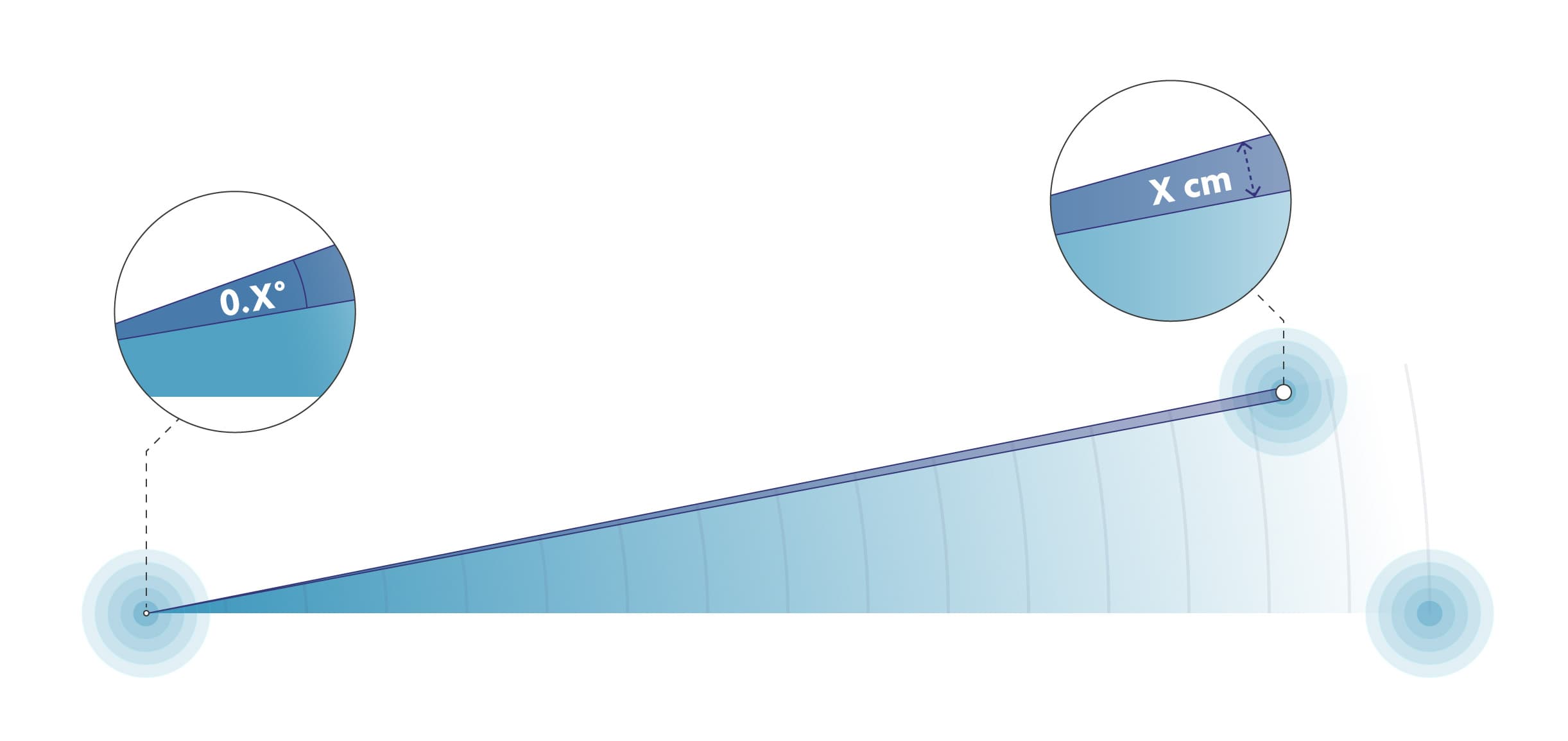
Moreover, the angular resolution of mechanical lidar does not meet the requirements needed for activities such as long-range scanning. For example: to resolve a cm-scale object from 200-300 m, you need an angular resolution in the order of 0.01°.
By integrating all lidar components on one integrated circuit, solid-state lidars overcome all these drawbacks. They’re compact, contain no moving parts, and can be mass-produced (wafer level) at a relatively low cost per device.
Imec’s building blocks for solid-state lidar
Whether you’re building a time of flight (ToF) or frequency-modulated continuous wave (FMCW) lidar system, imec’s generic platform offers you the mature building blocks you need. Both standalone SiN and SiN-on-SOI technologies combine:
- the high-power handling, low propagation loss, and low phase noise of SiN
- the efficient phase shifting, compact circuits, and integrated detectors of silicon
Explore this article for a deep dive into the technology. And this press release on our collaboration with Scantinel.
Moreover, imec’s solid-state lidar technology uses an on-chip detector array to ease the calibration without looking at the far field. This capability for on-chip calibration will reduce the complexity and maintenance cost of your lidar system even more.
This project received funding from the PhotonDelta National Growth Fund program.
Work with us
Want to accelerate your next-generation lidar application? Get in touch for access to imec's building blocks and expertise, including electronics, algorithms, IC/circuit and system design.
Imec not only helps you to address technological challenges. Thanks to our thorough knowledge of sectors such as automotive and robotics, we function as your full-fledged strategic partner – right down to venturing support.
Click the button below to get in touch.
Publications
W. Bogaerts, et al. “A 2D Pixelated Optical Beam Scanner Controlled by the Laser Wavelength”, IEEE Journal of Selected Topics in Quantum Electronics, (2021)
External linkJ. Kjellman et al. “Silicon photonic phase interrogators for on-chip calibration of optical phased arrays”, SPIE OPTO, (2020)
External linkR. Jansen et al “Integrated Calibration-Free Scannable Structured Light for Fast High-Resolution LiDAR”, Integrated Photonics Research, Silicon and Nanophotonics, (2020)
External linkA. Martin et al. “Photonic integrated circuit-based FMCW coherent LiDAR”, Journal of Lightwave Technology, (2018)
External linkLeaflets
Lidar
DownloadRead more

Meet imec fellow Mircea Dusa
Mircea is a visionary scientist in lithography, with a deep understanding of photolithography and optical equipment built over many years.
Read more

How hyperscalers are rethinking AI infrastructure
To move data faster, farther, and more efficiently, the AI ecosystem is exploring RF silicon interposer technology that allows to heterogeneously integrate CMOS, BiCMOS, and III-V materials
Read more
ITF USA 2026 at SEMICON® West
From silicon to systems: building the AI future The pace of AI evolution leaves little room for certainty. Yet, several trends are clear: AI agents increasingly collaborating in orchestrated ecosystems are on the rise. Physical AI is a crucial next step, including (humanoid) robots transforming our homes and workspaces. In parallel, AI – just like advances in quantum computing – could help unlock breakthroughs in fields such as physics and biology. Building the AI future starts with a solid hardware foundation – from high-performance, energy-efficient compute in the data centers to low-power, real-time inference at the edge. ITF USA at SEMICON® West presents the building blocks for shaping the AI future. On October 12 in San Francisco, we take stock of the full AI deep-tech stack: from silicon to systems, from research to manufacturing. Discover ITF USA
View event