Lens-free imaging: key to compact, scalable, large-field-of-view and high-res microscopy
Use imec’s technology to enhance your application with automated, continuous microscopy.
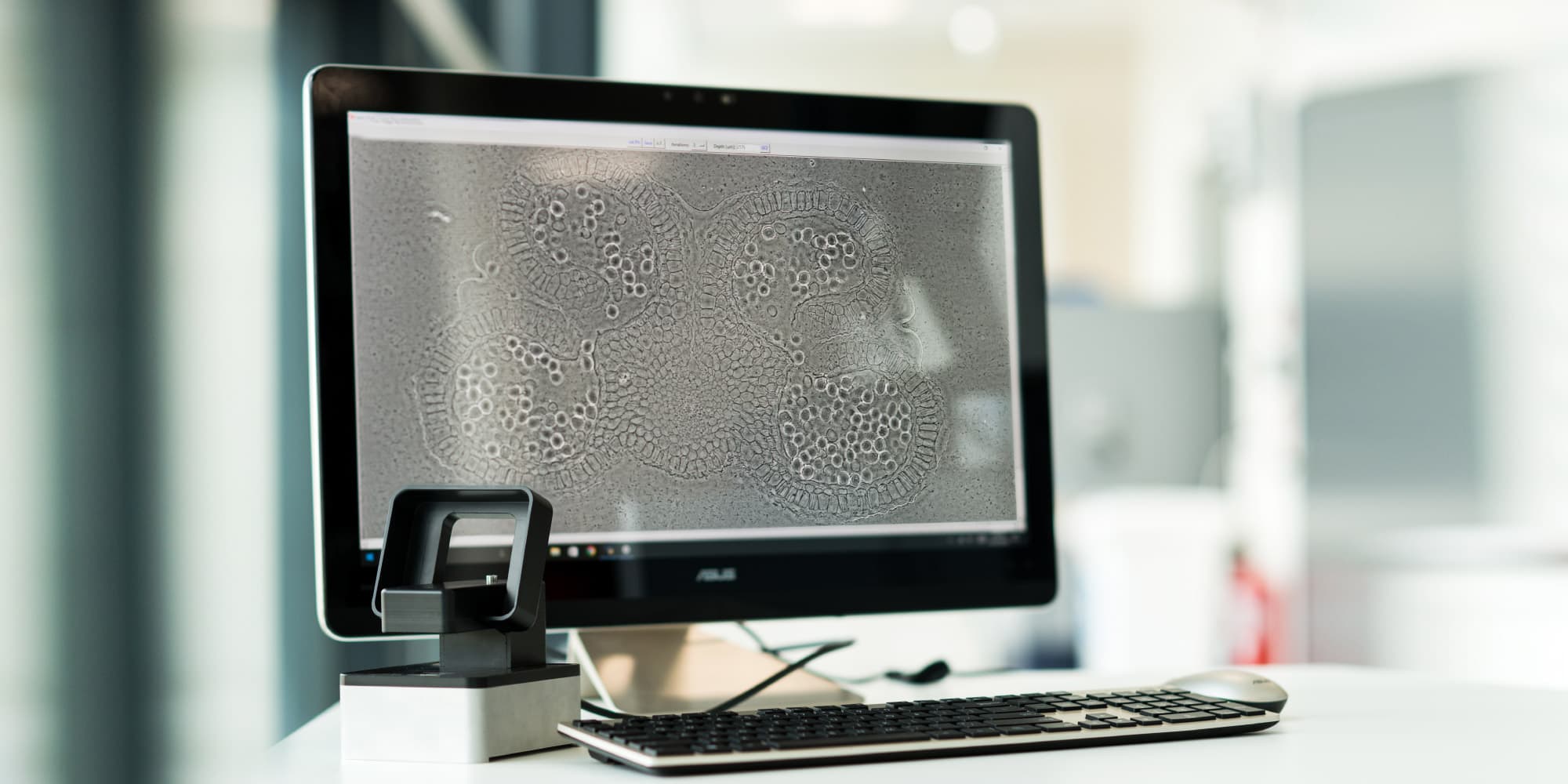
For centuries, we explored the microscopic world mainly through the glass lenses of traditional microscopes. But with the advent of digital image sensors came a new way to bring the imperceptible into focus: lens-free imaging. And it opens the door to many new applications.
Lens-free imaging, or computational microscopy, draws upon the latest advances in nano- and digital technologies. Yet its working principle is relatively straightforward:
- An illumination source lights up an object, such as a biological sample.
- The interaction of the light from the source with the light that reflects off the object results in an interference pattern.
- This interference pattern is captured by a digital image sensor.
- The resulting digital hologram is computationally processed into an extremely detailed image of the object – including depth information.
Advantages of lens-free imaging
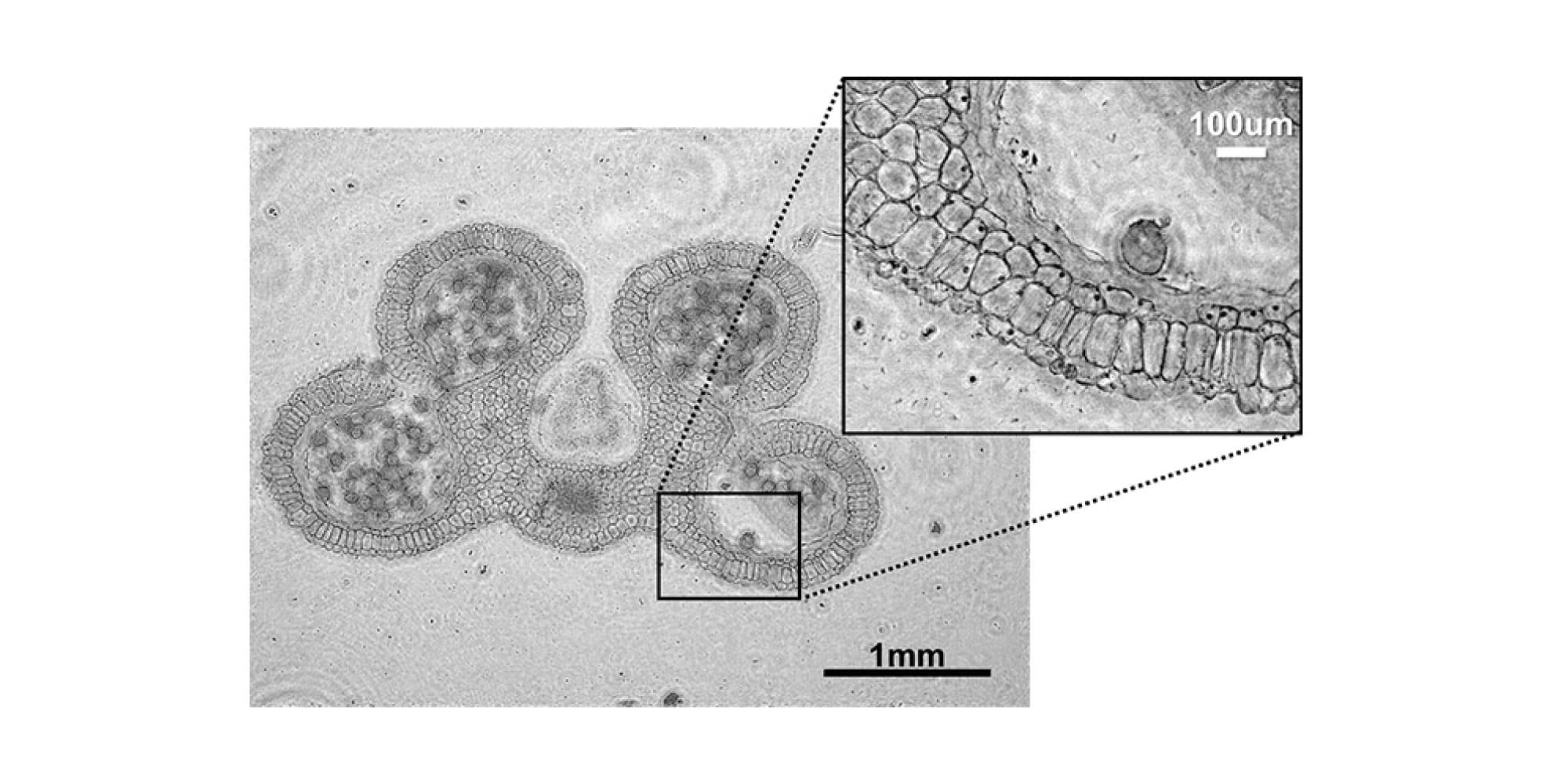
While the resolution of lens-free microscopes is at least the same as that of traditional devices, their field of view is much larger. Moreover, the elimination of lenses makes these microscopy systems more:
- compact – Because it’s the optics that make current microscopes bulky.
- robust – Since manual (re)alignments by skilled operators are no longer needed.
- affordable – Due to its compactness, LFI leads to reduced complexity. The costs are limited to a small amount of hardware, electronics and a computer.
These are, of course, impressive benefits in their own right. But most importantly, they make lens-free imaging highly customizable and relatively easy to integrate into a myriad of applications – especially targeting automatic, continuous and real-time monitoring.
Lens-free imaging applications
The purpose of lens-free imaging is generally not to replace traditional microscopy but to complement it. Lens-free microscopes are particularly suited for applications where ordinary microscopes would be too big, too expensive, or too limited in field of view.
In the domain of health and life sciences, lens-free microscopes are ideally suited for:
- fast, affordable and compact diagnostics
- in-line and automated bioprocess monitoring and control
- automated cell culture monitoring, for entire cell colonies as well as individual cells
Furthermore, lens-free imaging can be used for industrial applications such as airborne particle monitoring in cleanroom environments, and rapid inspection of thin-film displays during production – where the large field of view drastically reduces the necessary number of mechanical movements.
Imec’s lens-free imaging technology
Leveraging its semiconductor and digital technology expertise, imec developed a lens-free imaging system geared to easy integration into applications that require automatic identification and classification of moving cells, tissue, materials, ...
Some specifications of imec’s lens-free imaging solution:
- resolution: up to 1 µm
- field of view: 20 mm², or larger when using multiple imagers
- detection limit: 400 nm
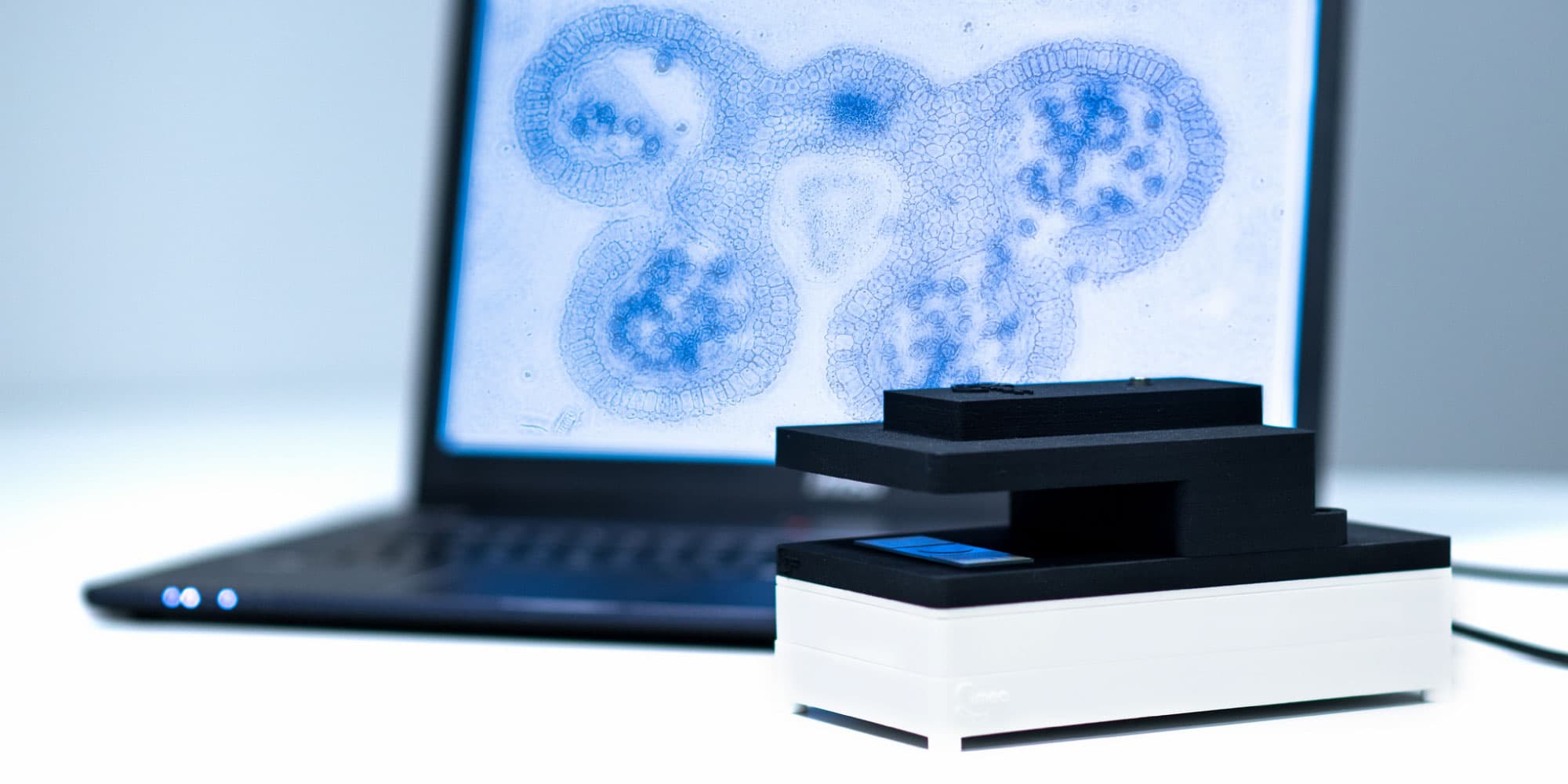
A plug-and-play evaluation kit is available to partners who want to customize this technology to their own requirements. This demo system includes all the necessary components to instantly take super-wide-FOV live images at µm resolution:
- light source
- image sensor
- control and read-out electronics
- host pc
- software
A next frontier: the lens-free fluorescent microscope
The development of brightfield lens-free microscopes is a big step forward for many clinical and research purposes. However, it falls short for applications that require the visualization of exceedingly small structures, such as DNA sequencing and targeted tests for specific molecules.
By selectively adding fluorescent labels to molecules, fluorescent microscopy is able to reach these much smaller resolutions. And just like brightfield microscopy, this technique could become drastically more accessible, affordable and applicable if brought on chip.
Lens-free fluorescent imaging is hard to achieve currently, although not impossible in the future . Fluorescent light is not coherent, a holographic reconstruction based on interference patterns cannot replace the function of the lens.
In the meantime, imec’s researchers are looking into a system that operates on the same principle as a traditional confocal laser scanning fluorescent microscope. A photonic circuit selectively excites fluorophores on the sample and collects the fluorescent light.
The goal is to build a 5-cm² system that reaches a resolution of 100 nm.
Explore this exciting research in more detail
Integrate our lens-free imaging technology into your application
Our off-the-shelf demo kit is ideal for exploring the value of lens-free imaging for your purposes. If you want to fully customize the technology to your application, our multidisciplinary team of physicists and biologists, system engineers and software experts is ready to:
- Tune internal parameters of the technology, such as acquisition speed and field of view.
- Investigate different form factors.
- Combine lens-free imaging with other technologies, such as microfluidics, cell sorting and inline/online bioprocess monitoring.
Imec not only helps you to address technological challenges. Thanks to our thorough knowledge of the health and pharma sector, we function as your full-fledged strategic partner – right down to venturing support.
Click the button below to get in touch.
Some examples of what we have done

Towards scalable single-molecule biosensing using carbon nanotube FETs
Imec achieves real-time biomolecule detection using a wafer-scale bioFET approach, marking a promising step towards high-throughput sensing for genomics and proteomics.
Read more
Programmable droplet processor
Imec’s programmable droplet processor allows steering millions of droplets at pixel level, enabling fully automated enrichment, purification, and separation workflows through programmable droplet interactions.
Read more

Imec builds nanopore platform for real-world assay innovations
Imec has made significant progress on its solid-state nanopore system that will enable life science companies to test and develop assays for single-molecule sensing. It is a cost-effective (mass-manufacturable), high-throughput solution.
Read more