Organ-on-a-chip technology
By mimicking human physiology on silicon, we improve our biological models without resorting to animal testing.
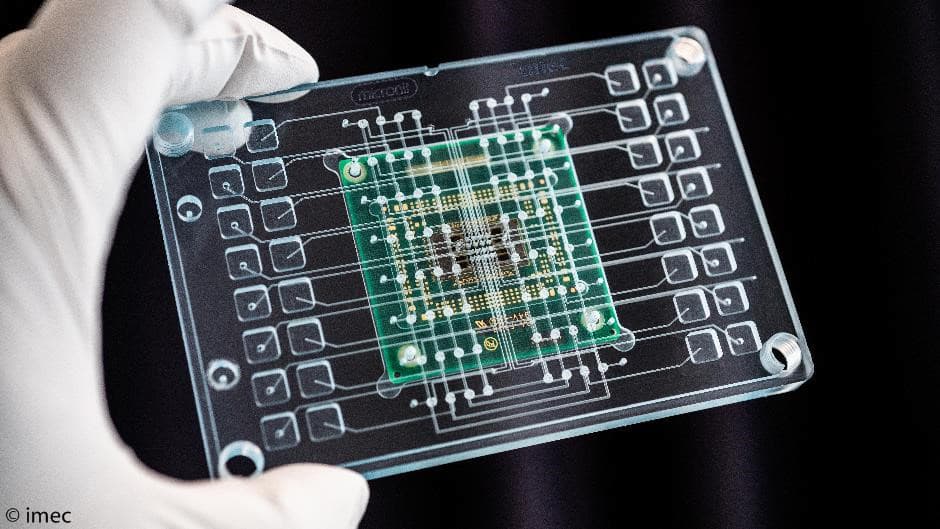
If we want to know how human biology functions at the cell and tissue level, we can turn towards two types of modeling: animal or in vitro. Animal modeling has ethical issues, can be expensive and time-consuming, and often inadequately reflects what happens in the human body. In vitro modeling is faster, more affordable and ethically acceptable. But is also not always representative of real in-body processes.
The in vitro test of the future is therefore one where cell and tissue activity is as close as possible to that inside the human body. Organ-on-a-chip technology achieves this through silicon devices upon which cells and tissue can grow. Micropatterns on the chip are developed together with the relevant biology. That allows for a more structured cell development to mimic that in specific organs. High-density electrodes offer stimulation, such as for electroporation. And/or they read out activity on a single cell level, which makes it possible to model wild-type versus mutant cell populations. Even lens-free microscopes can be added to monitor movements.
This vastly improved modeling method of human biology – both healthy and diseased – is associated with customized software analytic platforms. It results in more precise understanding and modelling of the data. Silicon devices allow for using patient-specific biology and mutations, enabling more personalized medicine. As silicon devices can be mass produced, this will drastically speed up drug screening and development.
Can we build a chatGPT for human biology?
Organ-on-a-chip technology blocks
Imec’s organ-on-a-chip platform is built on our various in-house capabilities:
- Microfluidics to culture and control the cells on the chip.
- Multi-electrode arrays for high-throughput, multi-modal cell interfacing.
- Biosensors for measurement of the cell analytes.
- Lens-free imaging for visualization of structures and movements.
- Data analytics to find patterns in the wealth of information and make predictions.
By fusing our high-density multi-electrode array (MEA) with a microfluidic plate with multiple wells, we are able to perform multiple tests in parallel on one chip – reaching an unsurpassed throughput.
Organ-on-a-chip applications
Imec leverages its organ-on-a-chip platform and combines it with bioscientific expertise to build systems that mimic a wide variety of human biological processes. The procedures are similar: use stem cell technology to reprogram skin or blood cells for specific functions, and create structures/circuits of these cells on chip.
Imec is actively looking for partners to further develop disease-on-chip models. Great progress is being made on brain-on-a-chip concepts that can help to decipher, and bring us closer to therapies for neurodegenerative diseases such as Parkinson’s and Alzheimer’s – a research avenue that is being explored within Mission Lucidity.
Other examples are:
- A heart-on-a-chip, complete with a lens-free microscope to observe beating movements, could advance cancer treatment by choosing which therapies put the least strain on a patient’s heart – an excellent example of personalized medicine.
- Modeling of the blood-brain barrier on chip could increase our understanding of this exceedingly complex structure and lead to new insights on therapy development and delivery.
Work with us
Want to partner with us in developing organ-on-a-chip models for specific applications?
Read more

Flanders’ deep-tech advantage: reinventing the drug pipeline
How imec and VIB are combining strengths to produce invaluable data in preclinical testing
Read more
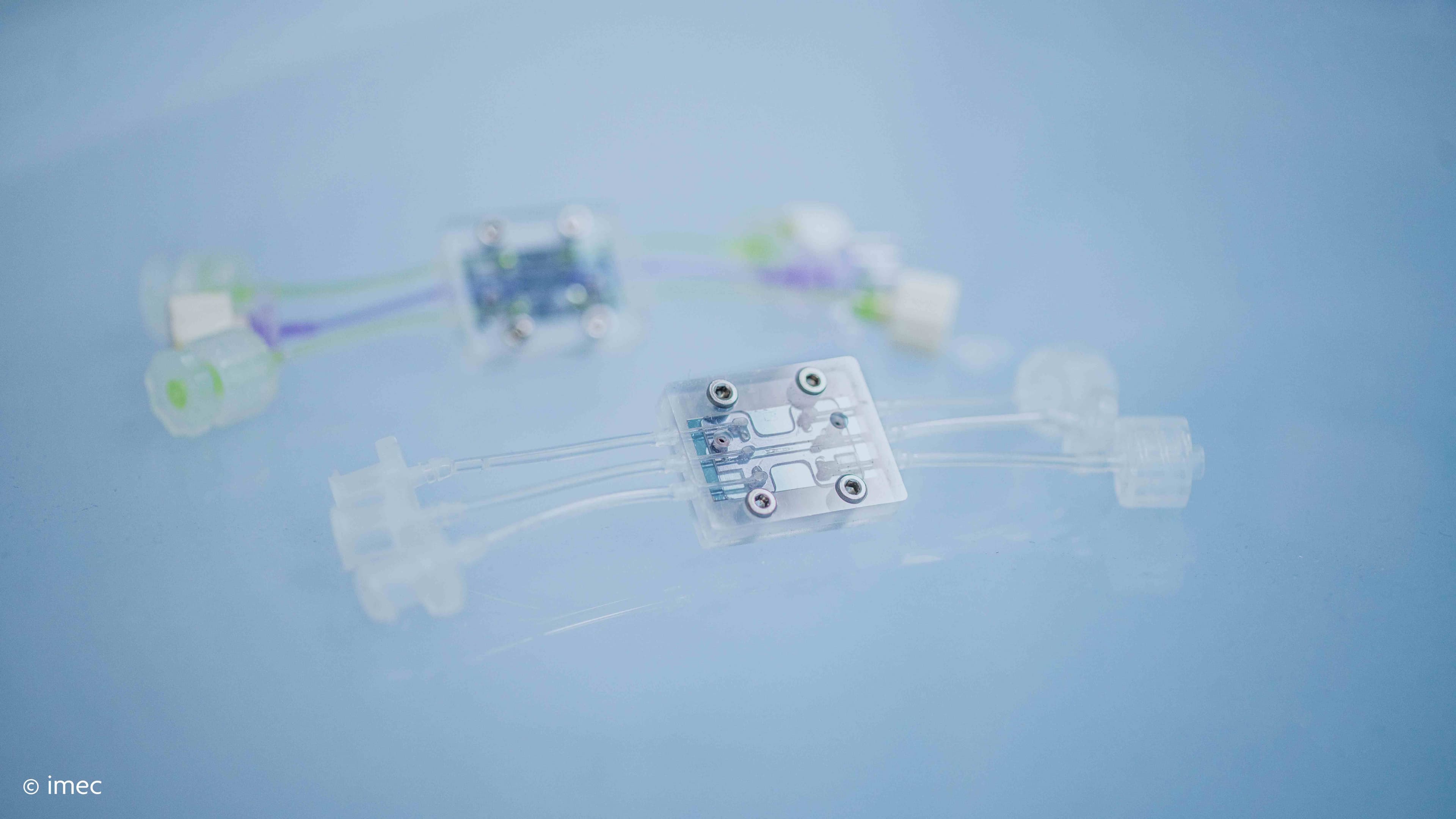
Merck and imec collaborate to develop a disruptive MicroPhysiological Systems platform
Industry-wide multipartner collaboration program aims to address the critical need for pre-clinical models in AI-driven drug development
Read more
ITF USA 2026 at SEMICON® West
From silicon to systems: building the AI future The pace of AI evolution leaves little room for certainty. Yet, several trends are clear: AI agents increasingly collaborating in orchestrated ecosystems are on the rise. Physical AI is a crucial next step, including (humanoid) robots transforming our homes and workspaces. In parallel, AI – just like advances in quantum computing – could help unlock breakthroughs in fields such as physics and biology. Building the AI future starts with a solid hardware foundation – from high-performance, energy-efficient compute in the data centers to low-power, real-time inference at the edge. ITF USA at SEMICON® West presents the building blocks for shaping the AI future. On October 12 in San Francisco, we take stock of the full AI deep-tech stack: from silicon to systems, from research to manufacturing. Discover ITF USA
View event