OCT technology
Develop the next generation of compact and robust scanners for bio applications such as OCT scanners with imec’s integrated photonics technology.
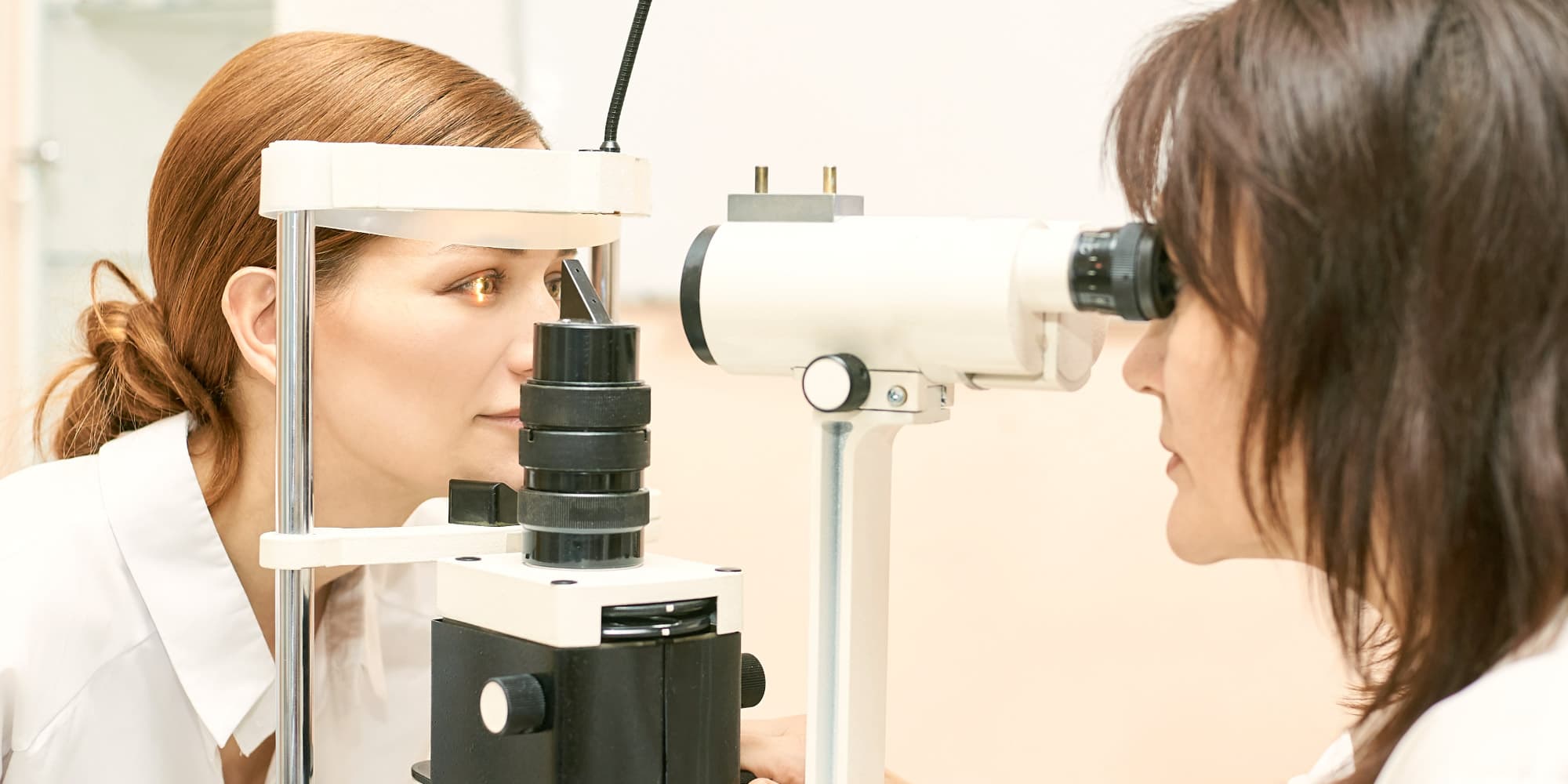
Optical coherence tomography (OCT) is an imaging technology for medical diagnostics. By measuring the intensity and echo time delay of light that’s scattered by transparent or semi-transparent tissues, OCT can capture 3D images with a penetration depth of several millimeters and a resolution of a few micrometers.
Its fine resolution makes OCT a powerful technology for applications where other imaging techniques, such as sonography or magnetic resonance imaging (MRI), fall short. Regularly used for retina imaging, it can discover early signs of glaucoma, macular degeneration, cysts, holes, and tears.
OCT is a simple, painless, and quick procedure. That makes the technology ideally suited for point-of-care diagnostics. Especially if the OCT device can be made compact and robust. This is where imec’s solid-state optical beamforming platform comes in.
OCT technology based on integrated photonics
An OCT scan is generated by dividing the light from a broadband source into two arms:
- a sample arm aimed at structures at various depths of the sample, for instance, the posterior pole of the eye
- a reference arm which usually contains a mirror
The combination of reflected light from both arms results in an interference pattern that gives information about the sample.
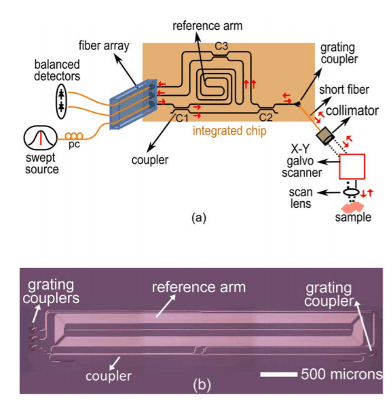
The key elements of an OCT system are:
- interferometer circuit
- scanner
- light source: broadband, wavelength-swept laser, ...
- corresponding light detector: simple, spectroscopic, ...
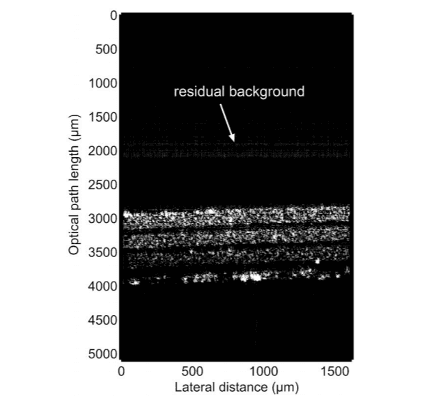
Using integrated photonics, imec first constructed an OCT system in 2010:
3D OCT technology
Standard conventional OCTs are based on a single-point 1D acquisition technique. To enable a more powerful 3D OCT, the technology needs to be complemented with a 2D scanning part.
For the development of such a 3D OCT, imec offers you different options:
- micro-electro-mechanical systems (MEMS)
- optical-phased-array scanners (OPA)
Whichever option you choose, imec’s expertise in integrated photonics guarantees you a compact, low-power, and reliable device.
Ready to work with us?
Publications
G. Yurtsever et al. “Ultra-compact silicon photonic integrated interferometer for swept-source optical coherence tomography”, Optics Letters, (2014)
External linkG. Yurtsever et al. "Integrated photonic circuit in silicon on insulator for Fourier domain optical coherence tomography", Optical Coherence Tomography and Coherence Domain Optical Methods in Biomedicine, (2010)
External linkRead more

Meet imec fellow Mircea Dusa
Mircea is a visionary scientist in lithography, with a deep understanding of photolithography and optical equipment built over many years.
Read more

How hyperscalers are rethinking AI infrastructure
To move data faster, farther, and more efficiently, the AI ecosystem is exploring RF silicon interposer technology that allows to heterogeneously integrate CMOS, BiCMOS, and III-V materials
Read more
ITF USA 2026 at SEMICON® West
From silicon to systems: building the AI future The pace of AI evolution leaves little room for certainty. Yet, several trends are clear: AI agents increasingly collaborating in orchestrated ecosystems are on the rise. Physical AI is a crucial next step, including (humanoid) robots transforming our homes and workspaces. In parallel, AI – just like advances in quantum computing – could help unlock breakthroughs in fields such as physics and biology. Building the AI future starts with a solid hardware foundation – from high-performance, energy-efficient compute in the data centers to low-power, real-time inference at the edge. ITF USA at SEMICON® West presents the building blocks for shaping the AI future. On October 12 in San Francisco, we take stock of the full AI deep-tech stack: from silicon to systems, from research to manufacturing. Discover ITF USA
View event