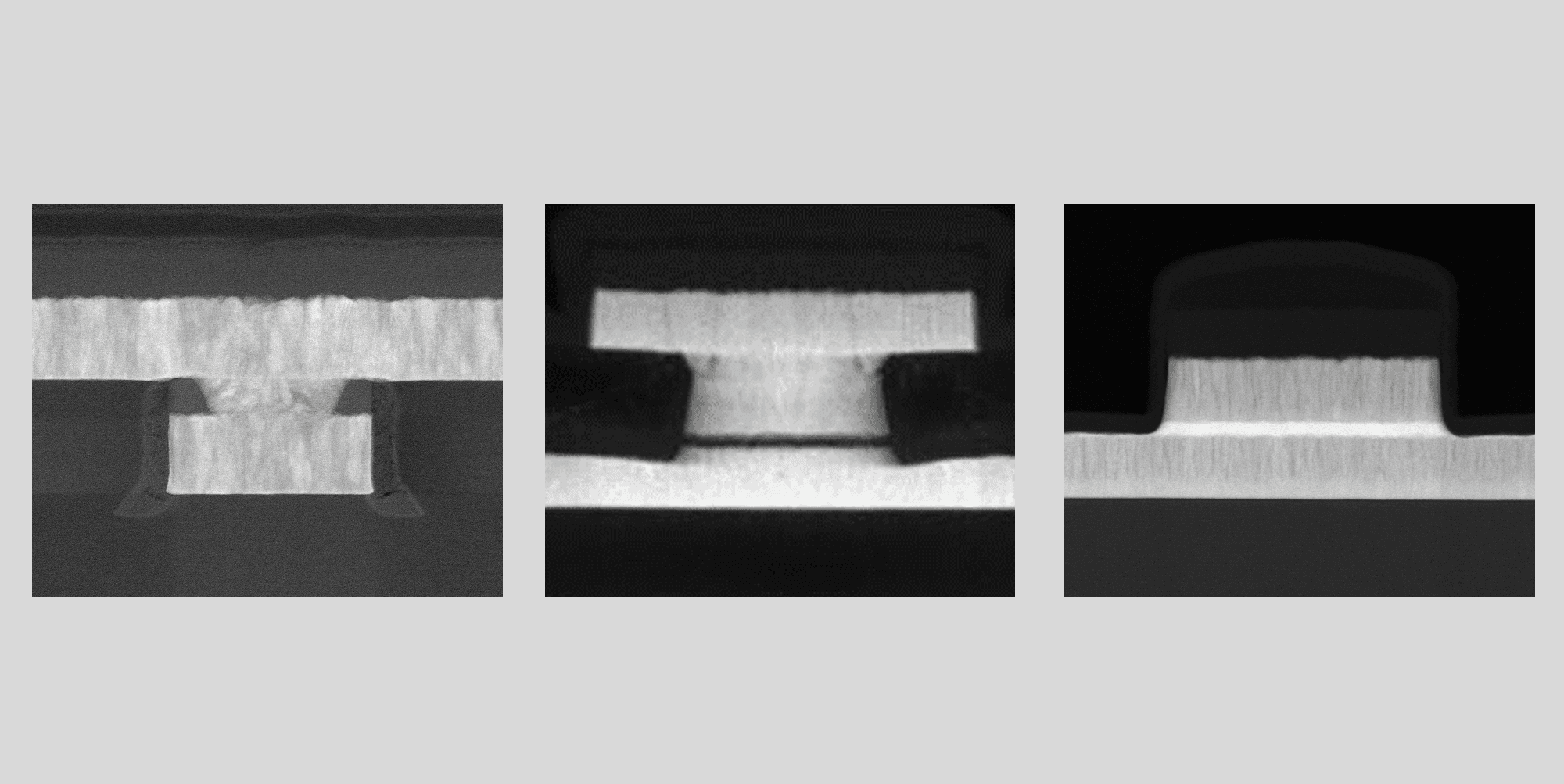
Imec presents alternative metals in advanced interconnect and contact schemes as a path to 2nm technology nodes
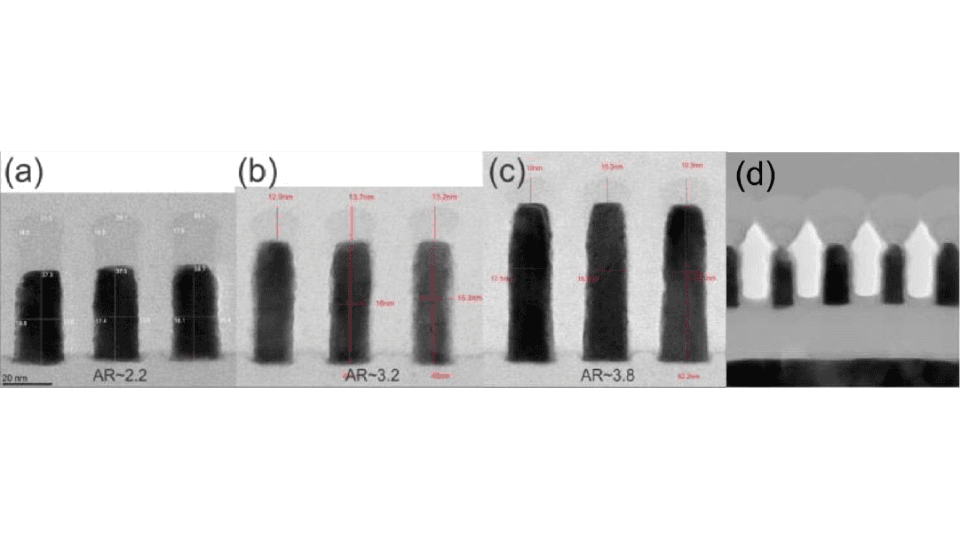
LEUVEN (Belgium), October 9, 2020 — At the 2020 International Interconnect Technology Conference, imec, a world-leading research and innovation hub in nanoelectronics and digital technologies, demonstrates for the first time electrically functional 2-metal-level interconnects fabricated with Ru semi-damascene and airgap technology showing a long lifetime and good mechanical strength. A complementary 12-metal-layer analysis confirms the system-level benefits of this semi-damascene technology in terms of RC, power consumption and IR drop. Ru was also shown as a promising alternative for contact plugs in the middle-of-line of advanced nodes. Alternative metallization materials such as Ru and alternative metallization approaches such as semi-damascene are intensively researched to scale the back-end-of-line (BEOL) and middle-of-line (MOL) towards the 2nm technology node and beyond.
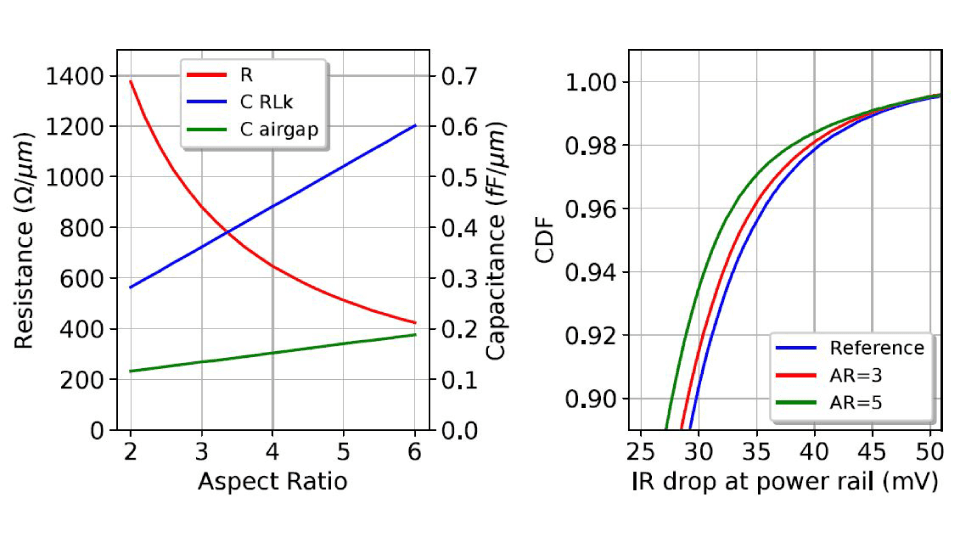
For the BEOL, imec proposes a semi-damascene integration as an alternative to traditional dual-damascene integration. To fully leverage the potential of the semi-damascene technology, metals other than Cu or Co are required that can be deposited without diffusion barrier, have a high bulk resistivity and can be patterned using e.g. subtractive etch. This allows for interconnect height increase which, in combination with airgaps as dielectrics, promises to reduce the resistance-capacitance (RC) delay – a major bottleneck for BEOL scaling.
“The results show that semi-damascene in combination with airgap technology not only outperforms dual-damascene in frequency and area, it also provides a scalable path for further enhancements."
Imec has for the first time fabricated and characterized a 2-metal-level semi-damascene module on 300mm wafers using Ru for the metallization. Devices with 30nm metal pitch line test structures showed more than 80 percent reproducibility (with no evidence of shorting) and a lifetime of more than 10 years. The mechanical stability of the Ru air-gapped structures was found to be comparable to traditional Cu dual-damascene structures. A complementary 12-metal-layer analysis revealed for the first time the system-level benefits of the semi-damascene approach in sub-3nm nodes – using a 64-bit ARM CPU as a benchmark design. Zsolt Tokei, program director nano-interconnects at imec: “The results show that semi-damascene in combination with airgap technology not only outperforms dual-damascene in frequency and area, it also provides a scalable path for further enhancements. Airgap shows the potential to improve performance by 10 percent while reducing the power consumption by more than 5 percent. The use of high-aspect-ratio wires can reduce the IR drop in the power network by 10 percent to improve reliability. In the near future, a newly developed mask set for the semi-damascene module will allow us to further improve the semi-damascene integration and to experimentally validate the predicted performance improvements.”
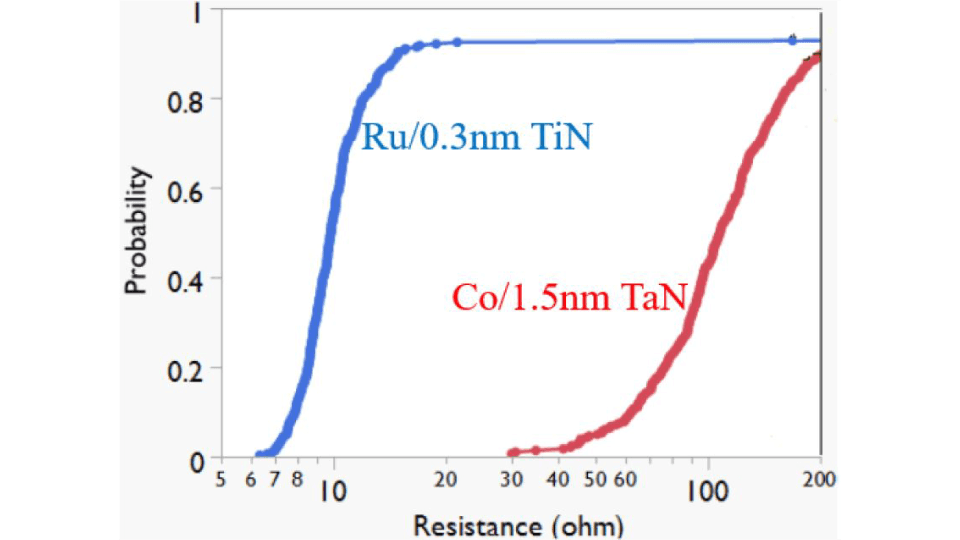
“Alternative metals such as barrier-less Ru have the potential to further reduce the contact resistance that results from shrinking the contact area. In a benchmark study, imec evaluated both Ru and Co. The results indicate that Ru is a promising candidate for replacing Co in narrow MOL trenches.”
Imec also demonstrated the beneficial impact of using Ru as alternative metal in advanced MOL contact plugs – as a replacement for W or Co. Naoto Horiguchi, director CMOS device technology at imec: “Alternative metals such as barrier-less Ru have the potential to further reduce the contact resistance that results from shrinking the contact area. In a benchmark study, imec evaluated both Ru and Co. The results indicate that Ru is a promising candidate for replacing Co in narrow MOL trenches.” The resistance of a Ru filled via on a 0.3nm TiN liner (without barrier) was shown to outperform the Co filled equivalent process (with 1.5nm TaN barrier). Ru as a source/drain contact material was also demonstrated, with low contact resistivity in the order of 10-9Ωcm-2 on both p-SiGe and n-Si.
About imec
Imec is a world-leading research and innovation hub in nanoelectronics and digital technologies. The combination of our widely acclaimed leadership in microchip technology and profound software and ICT expertise is what makes us unique. By leveraging our world-class infrastructure and local and global ecosystem of partners across a multitude of industries, we create groundbreaking innovation in application domains such as healthcare, smart cities and mobility, logistics and manufacturing, energy and education.
As a trusted partner for companies, start-ups and universities we bring together more than 4,000 brilliant minds from almost 100 nationalities. Imec is headquartered in Leuven, Belgium and has distributed R&D groups at a number of Flemish universities, in the Netherlands, Taiwan, USA, and offices in China, India and Japan. In 2019, imec's revenue (P&L) totaled 640 million euro. Further information on imec can be found at www.imec-int.com.
Imec is a registered trademark for the activities of IMEC International (a legal entity set up under Belgian law as a "stichting van openbaar nut”), imec Belgium (IMEC vzw supported by the Government of Flanders), imec the Netherlands (Stichting IMEC Nederland, part of Holst Centre and OnePlanet, supported by the Dutch Government), imec Taiwan (IMEC Taiwan Co.), imec China (IMEC Microelectronics (Shanghai) Co. Ltd.), imec India (Imec India Private Limited) and imec Florida (IMEC USA nanoelectronics design center).
Discover more

A double world-first: integrating lithium niobate and lithium tantalate modulators on silicon photonics through micro-transfer printing
Read more
Imec demonstrates 16nm pitch Ru lines with record-low resistance obtained using a semi-damascene integration approach
Read more