Towards circular business models for the PV sector
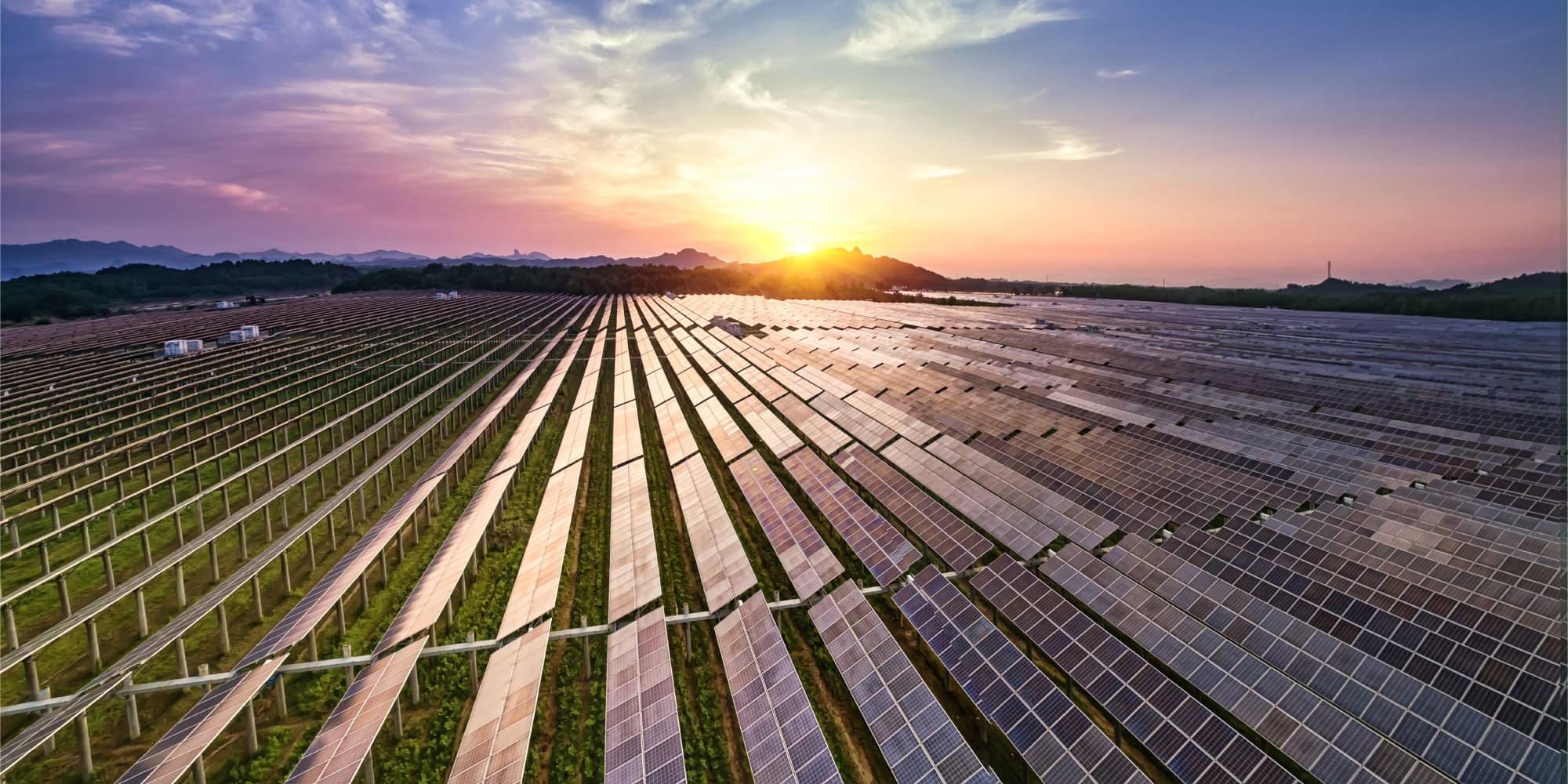
With solar energy about to reach the iconic Terawatt milestone of globally installed PV capacity, waste handling and end-of-life (EoL) scenarios become a pressing matter. Imec and its partners lead the way to a circular supply chain.
This article is an extract of a scientific review paper. At the bottom, you can find references to obtain the full details of this subject matter.
Partly under the umbrella of the EU-funded H2020 project CIRCUSOL, imec and its partners create technology and business insights – and raise awareness for – a circular supply chain in the PV sector. Spanning the entire spectrum that includes recycling, recovery of raw materials, repair/refurbishment and even re-use of decommissioned or failed PV modules. Eszter Voroshazi, group leader of the module and system activities at imec, and Ioannis Tsanakas, Marie Curie Researcher at imec, explain the why, how, what of circular PV. They are both active in EnergyVille, a partnership between imec, VITO, KU Leuven and UHasselt, which focuses on smart cities and smart grids.
Megatons of waste, tons of opportunities
The solar photovoltaic (PV) energy industry is experiencing a radical growth, particularly over the last decade. Nearly eighty percent of the worldwide PV installations have been deployed only during the last five years. The installed PV capacity today exceeds five hundred Gigawatt peak and is expected to overtake one Terawatt peak by 2022.
On the shadow side of this success, the number of PV modules that reach the end of their useful first-life will also greatly increase. Without effective end-of-life management, they will accumulate proportionately as PV waste. Studies estimate the global PV waste could reach up to eight million tons by the end of 2030 and even a tenfold cumulative of up to eighty million tons by 2050. Not yet taking into account the waste originating at the production level or resulting from installations being decommissioned before their ‘technological retirement age’ (e.g. because of insurance claims, repowering…). For comparison with other waste streams: the amount of waste resulting from plastic packaging in Europe alone surpasses 15 million tons annually.
Rather than considering this a mountain too high to climb, the PV sector and affiliated stakeholders are already looking at this evolution as an upcoming era of opportunities.
Potentially leading to new financing mechanisms and multiple revenue streams across the whole PV value chain. Not coincidentally, significant shifts of R&D efforts and business attention can be observed towards streamlined PV operations and maintenance (O&M), to ensure maximum and cost-efficient first-life operation of PV components. As well as to sustainable (profitable) EoL management and repair procedures, to establish long-term and competitive performance and reliability during their potential second life.
A myriad of possible approaches
PV recycling, recovery of raw materials, repair or refurbishment of decommissioned, failed or degraded PV modules and their recommissioning (second-life PV modules), are indispensable for a more sustainable, environmentally friendly and economically viable solar PV energy-based future.
Quite some research has already been conducted and for example decision trees already exist to navigate these different options of EoL management. Yet, insights from the reported literature have been rather fragmented and somewhat one-sided. They largely focus on PV recycling processes and related innovation efforts. Leaving the potential value of PV re-use relatively unexplored. Also, knowledge or best practices in repair/refurbishment, reliability and certification/qualification of second-life PV modules have been scarce. And there is even less knowledge and awareness about the opportunities for additional value creation via circular business models.
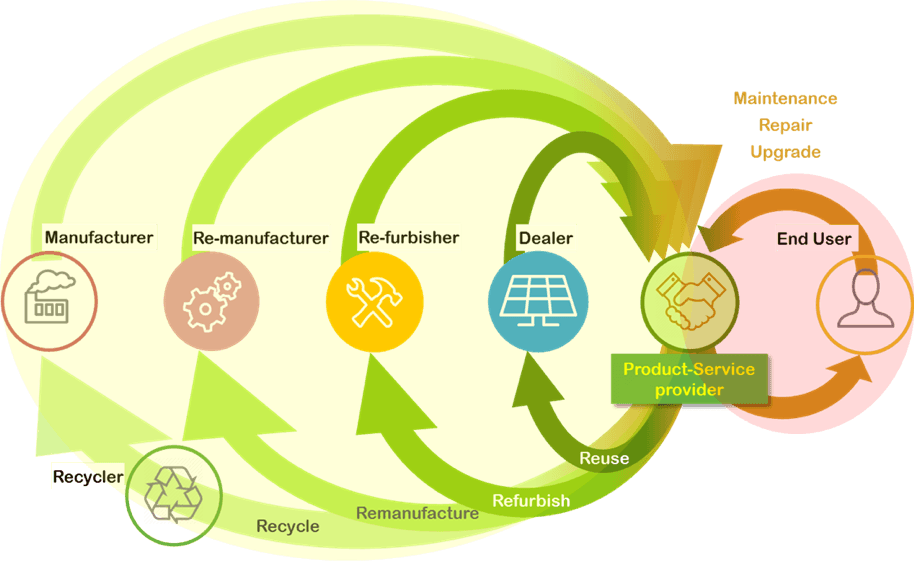
For example by more closely involving the original manufacturers and downstream stakeholders in relevant parts of the end-of-life processes.
CIRCUSOL sheds light on the matter
CIRCUSOL (short for ‘circular business models for the solar power industry’) is an Innovation Action project funded by the Horizon 2020 program of the European Commission. Coordinated by VITO (Flemish Institute for Technological Research), it brings together 15 partners from 7 different countries. Started in 2018 and running for four years, the program aspires to formalize the various EoL segments in the PV value chains and to propose adapted technical standards and regularity frameworks for them. Based on this knowledge, the program aims to develop and validate a Product-Service System (PSS) that enables the implementation of circular business models throughout the value chain.
First insights from the program already prove to be highly valuable. Today, by default, once PV modules are decommissioned, they enter the waste stream and are either disposed or recycled. Because most PV installations are still relatively far from reaching their expected end of life, the majority of today’s PV waste still results from product defects upon production, transportation or infant failures over the first four operational years. CIRCUSOL partners and experts estimate that around half of the PV modules that enter the waste stream can be actually repaired or refurbished and reused.
CIRCUSOL has made a comprehensive overview of the current status of players active in the various EoL scenarios as well as the state-of-the-art in supporting technologies and business models.
A little push by legislation
Those familiar with the PV sector will recognize that repair and refurbishment at present remain rather informal and certainly neither systemized nor standardized. In fact, these activities are currently performed by independent private companies, without any support from the original manufacturers. On this basis, today, there are only limited insights and hardly any standards on the characterization, reliability testing, certification or labelling for second-life PV modules. Yet, from a functional perspective and in view of the Low Voltage Directive (LVD) (2014/35/EU), relevant conformity assessment and safety requirements are still applicable, also for second-life PV modules.
Aside from this, the Waste Electrical and Electronic Equipment (WEEE) Directive (2012/19/EU) addresses the waste management requirements of all electronics’ waste in the EU member states. Indicating a 85/80 (%) recovery/recycling ratio of waste PV modules by mass should be recycled from 2019 onwards. It’s no secret that EoL and recycling technologies must evolve and become available to meet the increasing requirements of WEEE for the case of PV waste.
Joint effort to harvest future potential
All and all sufficient reasons for the PV sector and related stakeholders to put their shoulders under the challenges that need to be tackled and jointly reap the benefits of the various opportunities lying ahead. Including, but certainly not limited to, assessment and validation of PV design-for-recyclability and design-for-repairability concepts; development of tailored, cost-efficient reliability testing and characterization protocols for second-life PV modules; cost-profit and life cycle analysis for the PV re-use (i.e. second-life) business case. As partner in CIRCUSOL, imec warmly welcomes all contributions as well as requests for further information and interaction on this subject.
Acknowledgements
We acknowledge the valuable contribution of all project partners within CIRCUSOL (call: H2020-EU.3.5.4), as well as individual contribution in work, in the framework of PVMINDS (call: H2020-EU.1.3.2). These projects have received funding from the European Union’s Horizon 2020 research and innovation program under grant agreement 776680 and 752117 respectively. We also acknowledge that this work was partially funded by the Kuwait Foundation for the Advancement of Sciences under project number CN18-15EE-01.
Want to know more?
- Interested in the full details, including a list of scientific references? Upon simple request, you can obtain the full conference paper that was also at the basis of a presentation at the 36th European Photovoltaic Solar Energy Conference and Exhibition (EU PVSEC 2019) in September 2019 in Marseille (France)? Please contact us via this contact form.
- Express your interest in a dedicated informative workshop: in case of sufficient interest, imec and the CIRCUSOL partners would be more than happy to setup one or more dedicated informative workshops on the topic of circular PV. Please contact us via this contact form and you will be further informed.
- Homepage of the CIRCUSOL project.
- Homepage of EnergyVille.
- Overview of imecs’ expertise in Si and thin-film photovoltaics.
Authors

Eszter Voroshazi
Eszter Voroshazi is the group leader of the PV module and system activities at imec. She holds a degree in engineering from INSA in Rennes (2008, France) and a Ph.D. from the KU Leuven (2008, Belgium). Currently, in the framework of EnergyVille (a collaboration between imec, VITO, KU Leuven and UHasselt, which focuses on smart cities and smart grids), she is working on the development of innovative and sustainable special PV module technologies and materials, simulation-driven design of energy yields and R&M of PV systems. She also leads activities within EnergyVille. In addition, she is an expert in PV standardization and expertise committees, and reviewer for scientific funding institutions, conferences and journals.

Ioannis Tsanakas
Ioannis Tsanakas is a researcher of the PV modules and systems group at imec, in the framework of the EnergyVille collaboration (a partnership between imec, VITO, KU Leuven and UHasselt, which focuses on smart cities and smart grids). He holds a MSc/BSc in Electrical & Computer Engineering (2006) and a Ph.D. in Management & Industrial Engineering (2013), from the Polytechnic School of Democritus University, Greece. His professional/research interests are found in the fields of performance, reliability, O&M and sustainability of PV modules and systems. He is also actively involved in the International Energy Agency's PVPS program's Task 13, as a national scientific expert for France (2015-2016), Norway (2017-2018) and Belgium (2018-); also contributing as PV expert in relevant standardization committees (IEC) and European Commission task forces (EU-JRC Ecodesign; ETIP PV Digital Solar PV systems and Grid).
Discover more