New EU Quantum Flagship consortium launches a project on silicon spin qubits as a platform for large scale quantum computing
GRENOBLE, France – Feb. 4th, 2021 – A European consortium was launched today with the goal of scaling silicon quantum technologies. Named QLSI (Quantum Large-Scale Integration with Silicon), this four-year EU project, coordinated by CEA-Leti, will lay the foundation for the EU's industrial-scale implementation of semiconductor quantum processors and position Europe as a global leader in quantum computing. The project will focus on demonstrating that spin qubits are the leading platform for scaling to very large numbers of quantum bits, or qubits, the building blocks of quantum information processing.
The QLSI consortium features a dynamic team with a complementary skillset, bringing together experienced academics with deep knowledge of in silicon nanostructures and spin qubits, RTOs with silicon CMOS technology expertise, major international businesses in the semiconductor and computing industries, as well as Europe's thriving quantum start-up sector. Each member brings state-of-the-art expertise in their area required to address the challenges of building a scalable quantum computer.
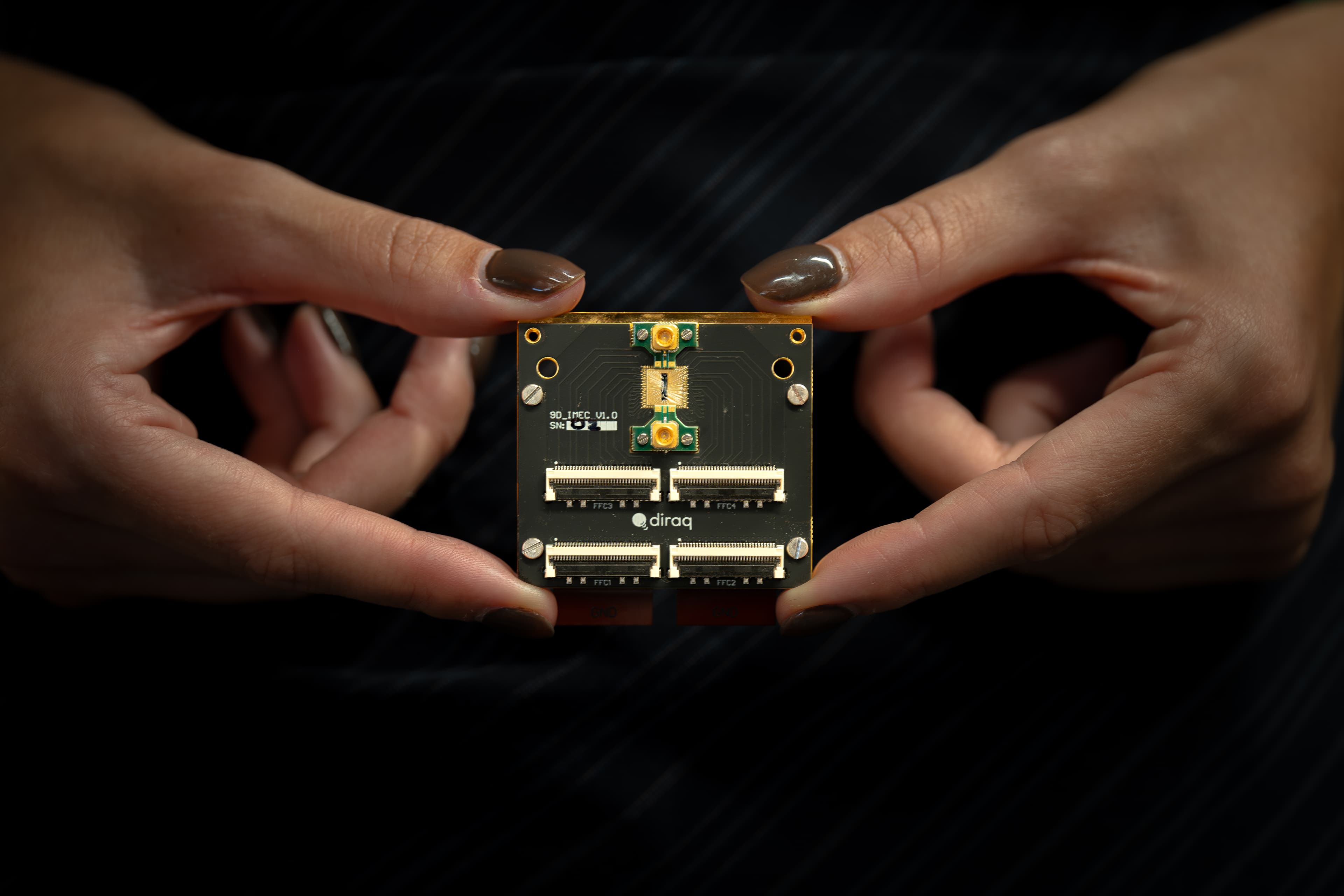
The partners have already realized many of the key advances in the field of silicon quantum, like CEA-Leti with a first step towards scaling in 2016 by demonstrating the first qubit fabricated by mass-production CMOS technology. The QLSI consortium will take this principle to the next level with the demonstration of a 16-qubit chip, and will also make an 8-qubit chip available for external use through the Quantum Inspire open-access quantum cloud environment. What makes silicon so attractive? Owing to their experience, the partners have already quantified promising single qubit performance: small size, high fidelity, fast read-out and manipulation. Working with silicon, the next step is to leverage the vast infrastructure of the global semiconductor industry.
Superposition and entanglement
While classical computers use information as bits that are either off or on, represented by '0' or '1', quantum systems utilize superposition and entanglement of particles, such as electrons or photons, or other quanta. In superposition, these qubits are at 0 and 1 states simultaneously. When qubits get entangled, a primary feature of quantum mechanics, a change in one of them causes the other to also change.
Harnessing these features will make it possible to use quantum effects to make major advances in computing, sensing and metrology, simulations, cryptography, and telecommunications. Society's benefits from quantum computing ultimately will include ultra-precise sensors for use in medicine, quantum-based communications, and hacking-proof digital data. In the long term, quantum computing has the potential to solve computational problems that would take current supercomputers longer than the age of the universe. These systems will also be able to recognize patterns and train artificial intelligence systems.
High-stakes, global competition
Europe is well-positioned to take the EU's spin-qubit R&D to the next level, in what is a high-stakes competition among advanced technological countries, said Maud Vinet, CEA-Leti's quantum hardware program manager, who will lead the four-year, €15 million ($17.7 million) project. The QLSI project ramps up a dedicated effort across all leading European groups in the field of spin qubits to develop complete processor systems that eventually will reach the thousands of qubits expected as a first step to show the potential for universal, error-corrected quantum computing.
QLSI will pursue four essential results:
- Fabrication and operation of 16-qubit quantum processors based on industry-compatible semiconductor technology
- Demonstration of high-fidelity (>99 percent) single- and two-qubit gates, read-out and initialization with these devices in a lab environment
- Demonstration of a quantum computer prototype, with online open-access for the community, integrating such a high-quality quantum processor in a semi-industrial environment (up to eight qubits available online), and
- Documentation of the requirements to address important issue of scalability towards large systems >1,000 qubits.
The project is a recent addition to the EU's ambitious Quantum Flagship program, a 10-year, €1 billion ($1.18 billion) R&D initiative launched in 2018. It is a coherent set of research and innovation projects selected through a thorough peer-review process. The overall goal is to consolidate and expand European scientific leadership and excellence in quantum computing, to kick-start a competitive European industry in quantum technologies and to make Europe a dynamic and attractive region for innovative research, business and investments in this field.
19 QLSI members for a consortium fully dedicated to quantum hardware solution delivery
CEA – development and fabrication of spin qubits | Univ. of Twente – physics experience and charge-and-spin properties of Si nanostructures |
TUD – demonstration of spin qubits | Univ. of Konstanz – theoretical simulations and modelling of spin qubits and their properties |
CNRS – demonstration of spin qubits
| Hitachi – physics experience and charge-and-spin properties of Si nanostructures |
IMEC – development and fabrication of spin qubits | IHP (Leibniz-Institut) – development of Si-based quantum materials for spin qubits |
TNO – demonstration of spin qubits
| ATOS – development of quantum validation platform |
Fraunhofer institutes IPMS & IAF – significant technological developments aiming at spin qubits https://www.iaf.fraunhofer.de/en and www.ipms.fraunhofer.de | STMicrolectronics – development of quantum validation platform |
Univ. of Copenhagen – demonstration and characterization of spin qubits | Infineon Dresden – development and fabrication of spin qubits |
UCL – physics experience and charge-and-spin properties of Si nanostructures | Quantum Motion – design and validation of spin qubit devices and architectures https://quantummotion.tech |
FORSCHUNGSZENTRUM JULICH / FZJ - demonstration of spin qubits | Soitec – significant technological developments aiming at spin qubits |
Univ. of Basel – physics experience and charge-and-spin properties of Si nanostructures | |
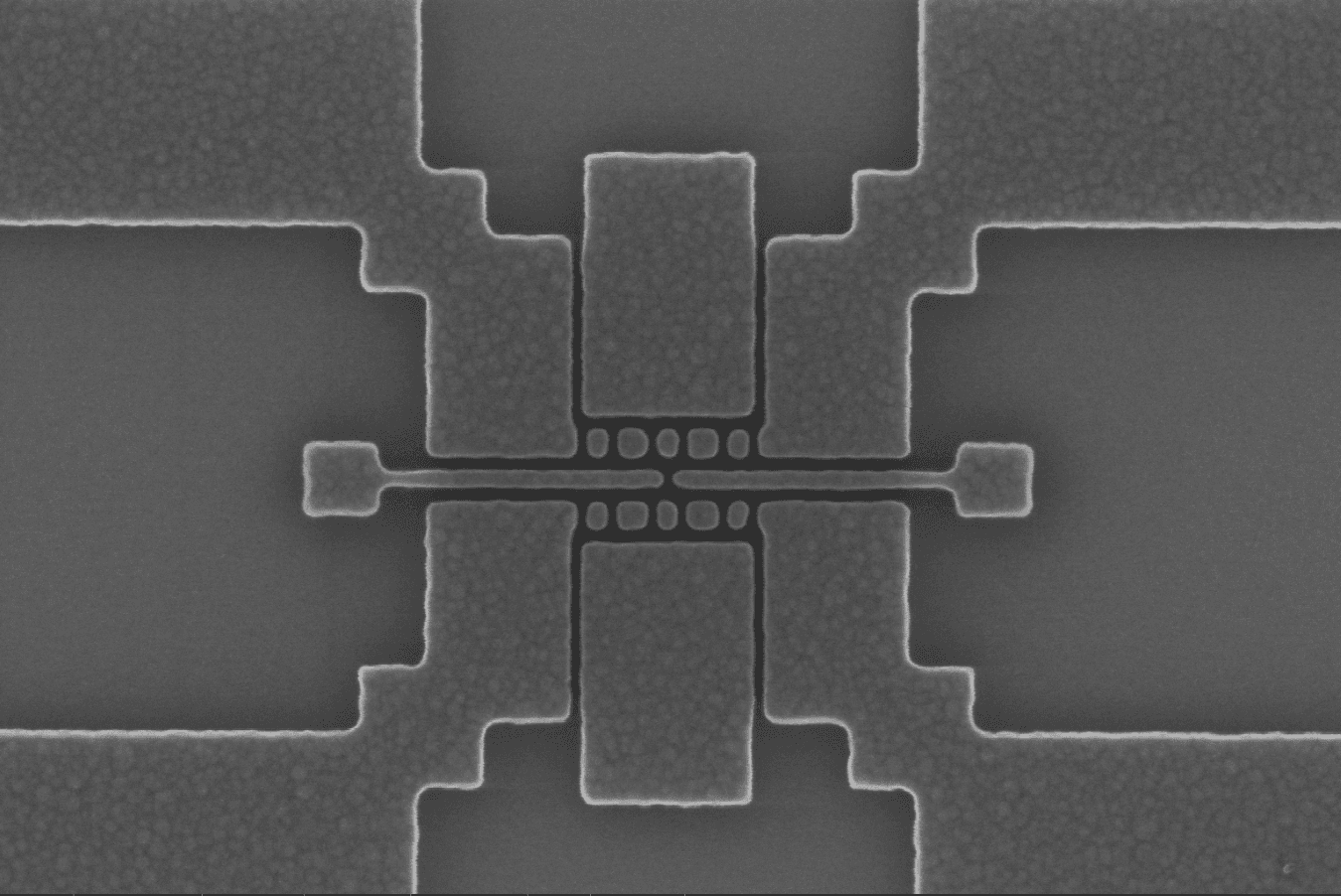
The partners have already realized many of the key advances in the field of silicon quantum. Imec’s has reported a 300mm platform for flexible spin qubit fabrication, which was recently highlighted at IEEE 2020 IEDM, and has developed a multi-physics modeling framework. This framework enables understanding qubit behavior and guides device design (Moving Quantum Computing from Lab to Fab | imec (imec-int.com)). The QLSI consortium will take these foundations to the next level with the demonstration of a 16-qubit chip at the end of the project.
Imec brings its flexible qubit platform in QLSI and works on improving single qubit performance and on designing and fabricating qubit arrays. Imec’s modeling capabilities are leveraged in developing design rules for large quantum systems and towards architecture definition.
Discover more


Anton Potočnik receives prestigious ERC Consolidator Grant to enable scalable superconducting quantum computers with qubit readout at near absolute zero (milliKelvin) temperatures
Read more
New leap in Belgian quantum communication infrastructure: imec, UGent and Belnet realize first QKD links
Read more