Cardiology Prepared For The Fourth Dimension
DIASTOLE prepares heart surgery by computer simulations in 4D
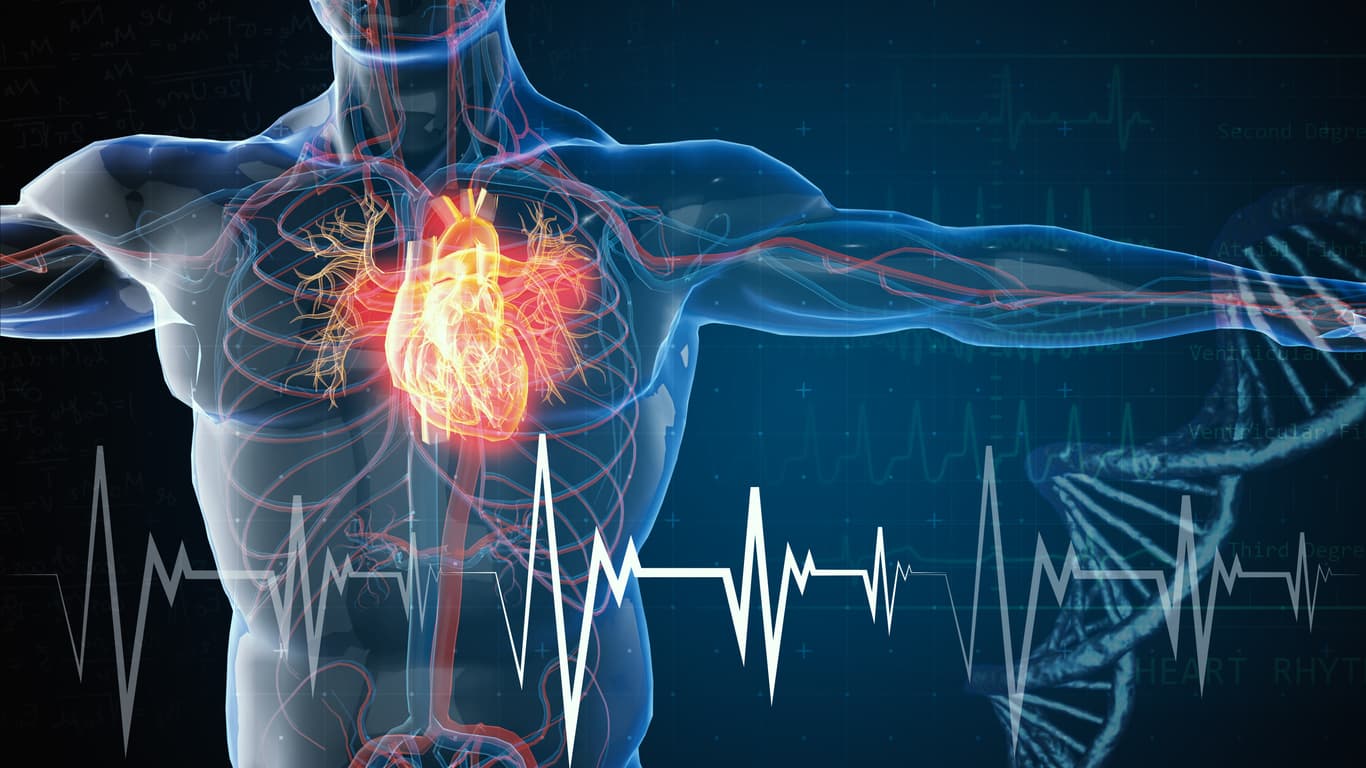
BRUSSELS (Belgium), March 5, 2021 — What if heart specialists could test the placement of a new heart valve before surgery, in 4D? 4D CT scanners add the dimension of time to three-dimensional images and capture the movement of the heart in detail. The imec.icon project DIASTOLE, involving VUB, UZ Brussels and imec, is paving the way to safely implement 4D scans in cardiac surgery.
The heart is an organ that is constantly moving and therefore hard to visualize. In cardiovascular procedures, it is often difficult to estimate how the heart will react to a stent or new valve. With 4D scanners, one could start to simulate in a safe way how a valve will function in a specific patient. 4D imaging becomes all the more important as today more and more operations are performed via the groin or through a small cut (keyhole technique) where the heart is only limited or no longer directly visible during the procedure. In order to safely deploy these 4D scanners in heart surgery, the various phases of imaging had to be reviewed. After all, the fourth dimension must be added in each step.
In the imec.icon project DIASTOLE, seven partners worked on those different steps. Researchers from the radiology department of VUB-UZ Brussel developed a model to calculate the radiation dose of 4D scans on the skin, and immediately applied it to draw up a safe protocol. Professor Nico Buls: “For a useful 4D scan, on the one hand the quality has to be sufficient, on the other hand you want to avoid the radiation dose becoming too high at certain locations on the body. Unlike conventional CT imaging, 4D scans involve multiple X-ray exposures over the same anatomical region which requires a thorough follow up of the skin dose.”
Professor Jef Vandemeulebroucke, from ETRO, an imec research group at VUB, investigated the image registration and segmentation: “Computers can recognize the heart on a 3D scan and, as it were, separate it from the rest of the body. This way, you get a clear 3D model of the heart. In 4D you basically have to repeat this for every 3D frame during the whole time frame. Our approach was to estimate the motion between the different images and to compensate for this motion such that you can align and superimpose the different images. Using this multi-atlas technique, we succeeded in creating high-quality models, allowing our partners in the consortium to use in their research.”
The centre for cardiovascular diseases at VUB-UZ Brussels looked at the complementarity with 4D ultrasound. GE Healthcare extended its patient dose registration software to include 4D scans; Materialise did the same for image processing software; Vision Lab, an imec research group at UAntwerpen, incorporated 4D in its statistical cardiovascular models. Finally, FEops made 4D simulations of a beating heart in which a cardiovascular device can be placed virtually. With the application, the doctor can upload 4D images of a patient to a website and have them analysed by FEops. Afterwards, the doctor receives a simulation of the type of implant that would be most appropriate, based on the scan.
“Based on the combined results, I hope we are one step closer to the real use of 4D in cardiac surgery. We now know it is safe, we can process the images and we can make simulations. The approach is feasible, and can be used in clinical applications,” says Vandemeulebroucke.
Future
The 4D scan can also be used for non-patient-specific applications. Provided there is sufficient data, it will also be possible to create a representative model that can be used to develop implants in different sizes.
About imec
Imec is a world-leading research and innovation hub in nanoelectronics and digital technologies. The combination of our widely acclaimed leadership in microchip technology and profound software and ICT expertise is what makes us unique. By leveraging our world-class infrastructure and local and global ecosystem of partners across a multitude of industries, we create groundbreaking innovation in application domains such as healthcare, smart cities and mobility, logistics and manufacturing, energy and education.
As a trusted partner for companies, start-ups and universities we bring together more than 4,000 brilliant minds from almost 100 nationalities. Imec is headquartered in Leuven, Belgium and has distributed R&D groups at a number of Flemish universities, in the Netherlands, Taiwan, USA, and offices in China, India and Japan. In 2019, imec's revenue (P&L) totaled 640 million euro.
Further information on imec can be found at www.imec-int.com.
Imec is a registered trademark for the activities of IMEC International (a legal entity set up under Belgian law as a “stichting van openbaar nut”), imec Belgium (IMEC vzw supported by the Government of Flanders), imec the Netherlands (Stichting IMEC Nederland, part of Holst Centre and OnePlanet, supported by the Dutch Government), imec Taiwan (IMEC Taiwan Co.), imec China (IMEC Microelectronics (Shanghai) Co. Ltd.), imec India (Imec India Private Limited) and imec Florida (IMEC USA nanoelectronics design center).
Discover more