PIONEERS
Can we increase the sustainability of ports while reducing CO2 emissions?
This page is also available in Dutch.
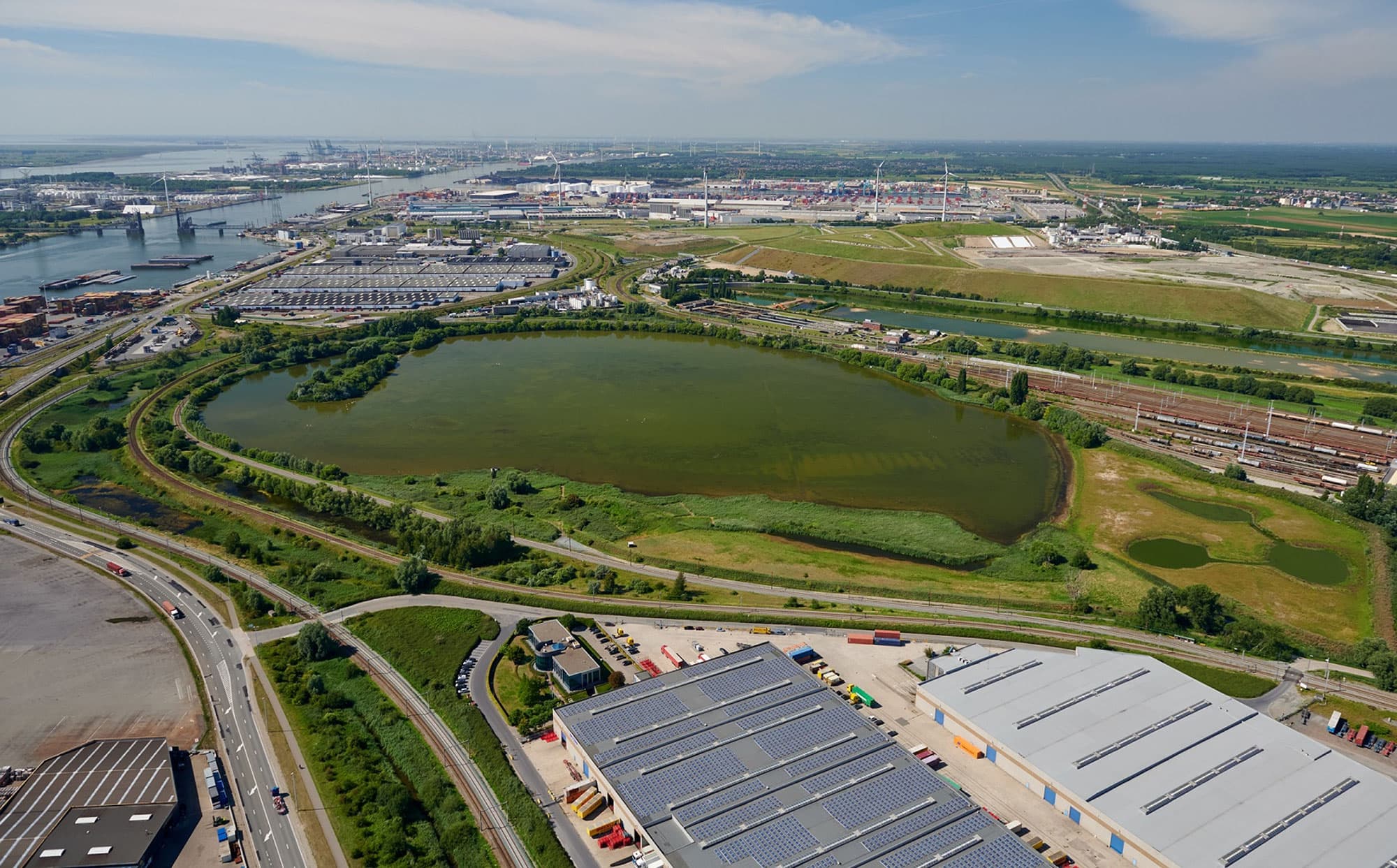
PIONEERS is a Horizon 2020 project that focuses on making ports more sustainable through several demonstration projects.
In October 2021 the Horizon 2020 project 'PIONEERS' was launched. The PIONEERS consortium investigates whether it’s possible to increase the sustainability of ports while reducing their emissions. Within the consortium, imec works on a digital twin that helps to improve decision-making around operational port processes to reduce their emissions.
The PIONEERS project is led by the Port of Antwerp and consists of 46 partners. Through a grant of 25 million euros and partnerships with leading ports, terminal operators, transporters, freight forwarders, knowledge institutions, technology developers, innovators and government agencies, the project works hard on solutions to reduce greenhouse gas emissions in ports while safeguarding their competitive position.
Division of roles between the ports
It’s no coincidence that Flanders is the pioneer of this consortium. With its 238,000,000 tons of cargo a year, the Port of Antwerp is the second largest seaport in Europe. It also offers an easy connection to the hinterland.
Therefore, within the project, the Port of Antwerp acts as a pioneer port that hosts a series of demonstration projects to show what a true green port looks like. The ports of Barcelona in Spain, Constanta in Romania and Venlo in the Netherlands are taking an active role in this by transferring solutions as much as possible to their surroundings and thus putting them into practice.
19 ambitious demonstration projects
PIONEERS aims to investigate various aspects of port activities, ranging from terminal operations and concession agreements on mobility, fuels and connectivity, to collaboration models for the production, storage and consumption of energy. The program runs until the end of 2026 and houses 19 ambitious demonstration projects in the domains of green energy production and supply, sustainable port design, modal shift, flow optimization and digital transition.
Some of the actions include generating renewable energy and introducing vehicles that run on electricity, hydrogen and methanol. In addition, buildings and heating networks get a makeover for better energy efficiency and a circular economy in infrastructure works. Finally, a 'port digital twin' helps to make strategic policy decisions.
Imec as digital twin demonstrator
As a strategic research center, imec has two objectives within PIONEERS:
- From April 2022, imec will build a 'port digital twin demonstrator' that will support partners within the consortium in making decisions with a view to reduced emissions and improved flow in the port. Use cases are being considered with a focus on better energy management, synchromodality of cargo, and better optimization and prediction of the movement of vehicles, vessels and containers. The challenge in building this digital twin is to cleverly obtain the necessary data sources and models.
- Later in the project, imec will investigate how the Port of Antwerp use cases can be applied to the other European ports participating in the project and what a blueprint for such a port digital twin should look like.
Want to know more?
Are you interested in imec's role within PIONEERS?
Then send an e-mail to joris.finck@imec.be.
For more information about the entire project: https://pioneers-ports.eu.

Read more

Meet imec fellow Mircea Dusa
Mircea is a visionary scientist in lithography, with a deep understanding of photolithography and optical equipment built over many years.
Read more
How hyperscalers are rethinking AI infrastructure
To move data faster, farther, and more efficiently, the AI ecosystem is exploring RF silicon interposer technology that allows to heterogeneously integrate CMOS, BiCMOS, and III-V materials
Read more
ITF USA 2026 at SEMICON® West
From silicon to systems: building the AI future The pace of AI evolution leaves little room for certainty. Yet, several trends are clear: AI agents increasingly collaborating in orchestrated ecosystems are on the rise. Physical AI is a crucial next step, including (humanoid) robots transforming our homes and workspaces. In parallel, AI – just like advances in quantum computing – could help unlock breakthroughs in fields such as physics and biology. Building the AI future starts with a solid hardware foundation – from high-performance, energy-efficient compute in the data centers to low-power, real-time inference at the edge. ITF USA at SEMICON® West presents the building blocks for shaping the AI future. On October 12 in San Francisco, we take stock of the full AI deep-tech stack: from silicon to systems, from research to manufacturing. Discover ITF USA
View event