COVID-19 and the medical uptake of off-the-shelf technologies
“A tribute to decisiveness” is what could summarize this article in one quote. In early February, global headlines announced: “China builds hospital for COVID-19 patients in only ten days!” At that time, the new Coronavirus still looked like a mostly Asian issue which was intriguing to the rest of the world, but did not cause behavior change for most of us. Meanwhile, triggered by progressive insights as the COVID-19 epidemic dramatically evolved into a pandemic, unprecedented measures have been taken all over the world. And what was being considered impossible in the medical sector only a few weeks earlier, has been realized in matters of days. Eric Van der Hulst, innovation manager of health at imec and Chris Van Hoof, vice president of R&D at imec, share their insights on some of these rapid evolutions in technology uptake in the medical sector in Belgium and internationally.
Off-the-shelf technologies
Chris Van Hoof: “Acting as columnist for de Artsenkrant, a Flemish news medium targeting doctors and medical practitioners, I regularly report on the trends and evolutions in state-of-the-art technologies that could be relevant for the medical sector. Usually referring to solutions that will only become available, let alone mainstream, in a few years from now. It had already occurred to me that this could, incorrectly, make me look as if I ignore the realities of the day and all the valuable technology solutions readily available. Little did I know that COVID-19 would give me the opportunity to pay tribute to off-the-shelf technologies.”
Eric Van der Hulst: “From 2016 to 2018, I was the project leader for action point 19 ‘Mobile Health’ in the strategic eHealth plan for Belgian government. The result was a validation pyramid concept for mhealth applications. With mhealthbelgium.be, an online repository of mobile applications that are CE-marked as a medical device, as one of the most visible outcomes. With most of our other recommendations, as well as actual implementations of the technologies listed on the online platform, ending up as subject of seemingly endless discussions between stakeholders from the technology, policy and medical sectors. Which is understandably inherent to a sector that is, rightfully so, heavily regulated and in which the voice of each stakeholder is valuable and needs to be heard.
Yet, looking at the contrast of what has been possible in the past few weeks and merely considering the impact on the uptake of new technologies, COVID-19 could already be called revolutionary.
A matter of urgency: dream or nightmare?
Where does this leave us today? In Belgium, teleconsultations have been adopted almost throughout the entire healthcare system. Also, call centers have been put in place as first points of contact, taking away some of the pressure downstream. Previously, some patients would immediately rush to their general practitioner or hospital emergency center at the first symptom of sickness. Today, many everyday health concerns are being tackled remotely, and medical professionals are able to evaluate and refer patients to an in-person clinic for more complex or critical needs. To support this role as first-line assistance and triage, medical experts have created standardized decision trees, which are continuously updated to ensure they are in line with the latest clinical insights. This allows for better and more reliable comparisons between cases and regions.
Furthermore, the media has reported that diving masks from sports shops are being transformed into protective masks or medical ventilators in order to compensate for shortages in protective gear or medical machinery. For distributed manufacturing (via 3D printing etc.) of crucial parts of medical equipment, companies of all sizes are upscaling or completely transforming their production to compensate for these shortages. Patients and medical staff are being transported between countries and regions to make sure that, as much as possible, patients can get appropriate help. CT-scans, artificial intelligence, online apps, and many other solutions are being deployed to obtain short-term diagnostic indications while waiting for the more conclusive clinical test results to return from the lab.
If you were to re-read the previous two paragraphs, and imagine them in a world without COVID-19 or another pandemic, it might sound like a future vision rather than an existing reality.
Chris Van Hoof: “Even despite the tragic reality of COVID-19 and the nightmare a lot of us are living in, an emergency doctor and a daily practitioner from within my personal network both testified that in some ways their professional context was now better organized than before, enabling them to focus on the tasks at hand.”
A tribute to decisiveness
Of course, the overall experience of COVID-19 is far from positive for most of us, but in analyzing the mechanisms behind this fast medical reform, we can celebrate decisiveness. Zooming in on Belgium, teleconsultation is, for example, only experiencing a breakthrough now that the government is allowing reimbursements by social security and medical insurance. First approved for general practitioners only, then a few weeks later followed by sessions with psychologists, psychiatrists, and other specialists. And call centers owe some of their success due to the appointment of civil servants that man and support them.
Also, the uptake of new technologies for diagnoses and treatments by doctors and hospitals are being accelerated because great urgency makes ‘ignorance is bliss’ type of arguments and internal procedures disappear.
Chris Van Hoof: “In the case of the emergency doctor I mentioned earlier, she and her colleagues have been given Bluetooth headsets so they can answer calls without having to constantly remove their protective gear. A simple piece of technology that makes their work easier also in regular times, and which moved at accelerated pace through the internal procedures as COVID-19 came along.”
Eric Van der Hulst: “Healthcare is one of those sectors where regulations are prevalent. Education is another one. In such regulated sectors, the main focus is on stability, not the least in budget management. Making it much harder to introduce novelties than in other sectors like sports or logistics. To a large extent, this focus on regulations and stability is of course justified and some of the thresholds that have now disappeared will return after the COVID-19 crisis. Yet, it has now been proven that innovation can be accelerated even in heavily regulated sectors if there is a common sense of urgency. Important leaps forward have been made and the current boost in technology uptake will have a lasting impact.”
It makes us hopeful that, when this crisis is over, we might look back at it as the reference for what more decisiveness could mean for the healthcare sector. And meanwhile, we keep applauding for medical staff and caretakers fighting COVID-19 on the frontlines, and especially for those who still too often have to perform miracles without adequate resources.
Want to read more on this topic?
A recent article in The Medical Futurist, looks at COVID-19 and the rise of telemedicine from a U.S. and global perspective, and comes to similar conclusions.
Authors

Chris Van Hoof
Chris Van Hoof is vice president of R&D, Connected Health Solutions at imec and leads teams at three different imec sites (Eindhoven, Leuven and Ghent). Imec's Connected Health Solutions teams create solutions for monitoring patients with chronic conditions and for preventive medicine using virtual coaches. Chris has brought wearable health within imec from fundamental research to a fully-fledged business line, with international customers and partners. Chris wants to develop products that really work and that are relevant for the industry, which has already led to the creation of five imec start-ups (4 in the field of health).
Chris obtained his PhD at KU Leuven in 1992, in collaboration with imec. He held various positions as manager and director in different research domains (sensors, image sensors, 3D integration, MEMS, energy harvesters, body sensor networks, biomedical electronics, portable health sensors). He is also a professor at KU Leuven.
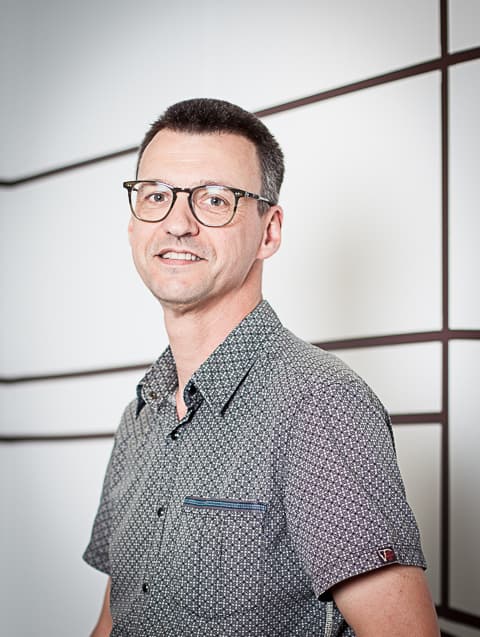
Eric Van der Hulst
Eric Van der Hulstis an Innovation Manager of Health at imec. He considers himself an evangelist of technology in healthcare with a mission to build bridges between researchers (including imec) and companies on the one hand, and governments, professionals and citizens on the other. In this way, he tries to promote innovation through healthcare technology and contributes solutions to the challenges our healthcare system faces.
Eric holds a master’s in computer sciences (VUB) and specialized through a master’s in CAE (UK) and a postgraduate in usability design (KUL). He started his career at Siemens, where after five years he joined the medical informatics department. Over the next 10 years, he was a project manager for healthcare applications at the UZA, before becoming a healthcare director for the software developer, Cegeka. Eric worked at the iMinds research center since 2014, prior to its merger with imec. He presently combines his experience in IT and care for the benefit of innovation.
Discover more