Imec’s SWEET study collects world’s largest dataset on stress detection
Largest study of its kind harnessed wearables to uncover links between stress and physiological factors

LEUVEN, Belgium - Jan. 9, 2018 – Imec, the world-leading research and innovation hub in nanoelectronics and digital technologies, announced today that it has collected the largest multisensor dataset worldwide on stress detection. Imec’s Stress in the Work Environment (SWEET) study captured data from more than 1,000 people and is the first large-scale study that used clinical-grade wearables to establish the link between mental stress and physiological symptoms in daily life.
Work-related stress is common in modern-day society; however, while everyone experiences occasional stress, chronic stress can have a significant and long-term impact on emotional and physical well-being, and it can cause depression, anxiety disorders and professional burnout. According to the American Institute of Stress, stress is estimated to cost the US economy approximately 300 billion dollars a year (due to absenteeism and productivity loss). In Europe, the annual cost of stress is estimated at 514 billion euros in productivity loss and 63 billion euros in direct healthcare costs. Currently, the most widespread method to detect stress is by the means of questionnaires. However, these questionnaires are subjective, time-consuming, and are conducted on a spot-check basis only. To lower the risk of reaching the threshold of chronic stress, it is important to identify stress signals immediately and to provide personalized, just-in-time feedback so that the individual can employ correction strategies to decrease his/her stress level. Imec’s wearable technology in combination with advanced algorithms to analyze the data collected can play an important role in this.
Imec’s large-scale research, the SWEET study, tracked more than 1,000 participants. First, participants’ baseline stress levels were determined via validated psychological questionnaires. They were then provided a wrist band and a wireless ECG patch, which they wore continuously for five days. The ECG patch monitored their heart rate and heart rate variability along with acceleration (movement). The wrist band, fortified with advanced algorithms, measured skin conductance, skin temperature and acceleration (movement). Physiological stress symptoms were then supplemented by contextual data collected through the participants’ smartphones, such as GPS data, phone activity and noise level, and self-reported information.
Participants were queried 12 times a day via a smartphone app to evaluate their self-reported stress levels and to answer multiple-choice questions about their daily activities, food and drink intake, sleep quality, and digestive processes. In addition, they also completed the Montreal Imaging Stress Task, a 20 minute-stress test that allowed the researchers to calibrate participants’ stress levels with their personal physiological symptoms.
“Our SWEET study is unique as it is the first large-scale study to use multiple wearables to establish the link between physiological stress symptoms and self-reported stress in real-life. Utilizing wearables in this research generated complex and sophisticated data sets, taking real-life contextual factors into account that helped us better understand periods of stress and its indicators,” explained Elena Smets, imec.ichange researcher and PhD student at KULeuven. The first results, for instance, already indicated that participants’ average heart rate variability correlated with their perceived stress levels.
“This study is part of imec.ichange, imec’s research program that aims to stimulate and encourage healthier lifestyles by using wearable technology to give personalized and user-friendly feedback,” stated Chris Van Hoof, senior director connected health solutions. “The insights from the SWEET study, are an important starting point to develop this kind of technology for stress management. By providing personalized, context-enriched feedback via wearables, it will be possible to help people maintain a more balanced lifestyle, thereby reducing the risk of stress-related problems such as burnouts. Although the primary focus is on prevention, an adapted version of this technology could also be used to support patients recovering from a mental illness, i.e. by providing their therapists with objective information about patients’ stress symptoms in daily life.”

About the imec.ichange program
The imec.ichange program aims to develop a digital coaching tools for a healthier life, based on sensor technology and data science. By combining smart algorithms and contextual data, wearables and health apps can give more user-friendly, personalized, just-in-time feedback. The long-term goal is to combine this form of digital phenotyping with other aspects of the human fenotype and pave the way towards disease interception.
Imec welcomes companies to join our imec.ichange program to create an ecosystem of partners, including partners with medical expertise (hospitals, doctors, specialists, etc.), pharma, and companies specialized in hardware, data analysis, coaching, etc., to bring together all the different areas of expertise needed to validate diverse applications and create robust solutions.
About imec
Imec is the world-leading research and innovation hub in nanoelectronics and digital technologies. The combination of our widely acclaimed leadership in microchip technology and profound software and ICT expertise is what makes us unique. By leveraging our world-class infrastructure and local and global ecosystem of partners across a multitude of industries, we create groundbreaking innovation in application domains such as healthcare, smart cities and mobility, logistics and manufacturing, energy and education.
As a trusted partner for companies, start-ups and universities we bring together close to 3,500 brilliant minds from over 70 nationalities. Imec is headquartered in Leuven, Belgium and has distributed R&D groups at a number of Flemish universities, in the Netherlands, Taiwan, USA, China, and offices in India and Japan. In 2016, imec's revenue (P&L) totaled 496 million euro. Further information on imec can be found at www.imec-int.com.
Imec is a registered trademark for the activities of IMEC International (a legal entity set up under Belgian law as a "stichting van openbaar nut”), imec Belgium (IMEC vzw supported by the Flemish Government), imec the Netherlands (Stichting IMEC Nederland, part of Holst Centre which is supported by the Dutch Government), imec Taiwan (IMEC Taiwan Co.) and imec China (IMEC Microelectronics (Shanghai) Co. Ltd.) and imec India (Imec India Private Limited), imec Florida (IMEC USA nanoelectronics design center).
Contact
Hanne Degans, Press communications manager, +32 16 28 17 69 // +32 486 06 51 75 // Hanne.Degans@imec.be
Discover more

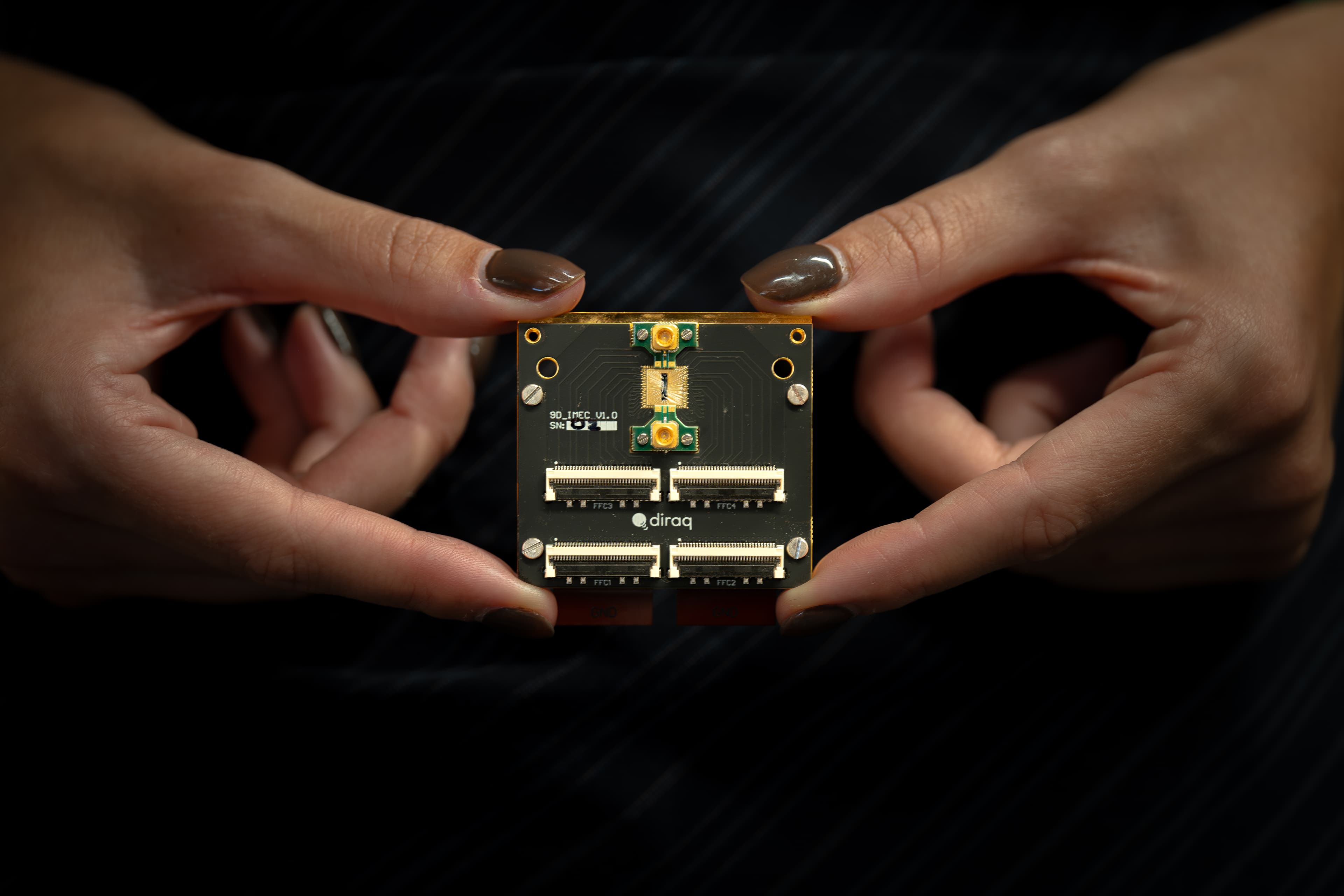
Imec and Diraq demonstrate first coherent operation of eight silicon MOS spin qubits fabricated in a 300mm CMOS-compatible foundry process
Read more
Neural telemetry breakthrough: new chip delivers ten-fold compression while preserving signal integrity
Read more