Imec joins euROBIN, a new unified European platform for R&D on AI-driven Robotics
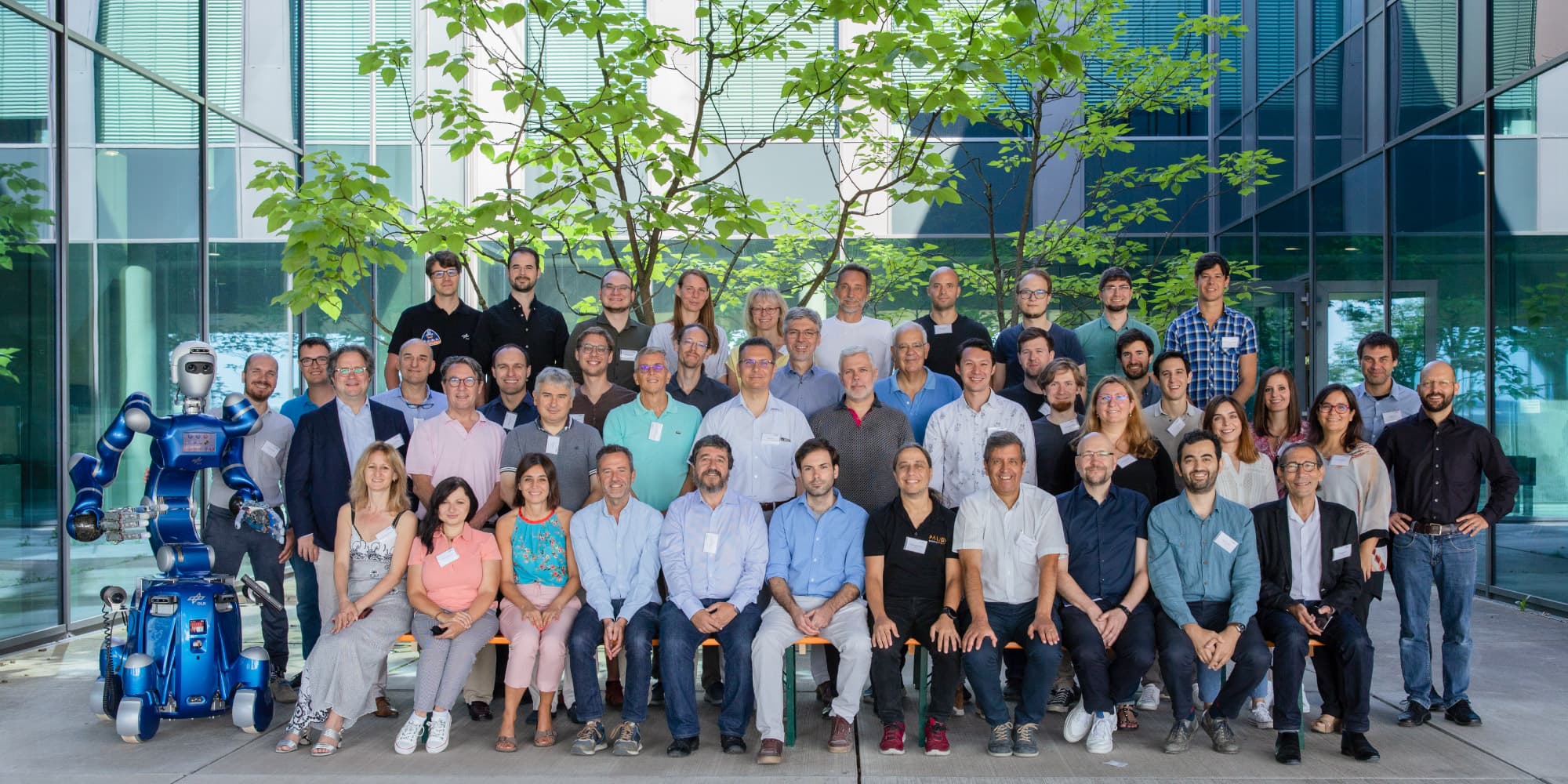
Leuven 22 July - For the first time, a large number of distinguished research labs across Europe are jointly researching on AI-Based Robotics. Goals include both significant scientific advances on core questions of AI-based robotics as well as strengthening the scientific robotics community in Europe by providing an integrative community platform. The network is open to the entire robotics community and provides mechanisms of cascade funding for doubling its number of members over the next years.
“Imagine a society in which robots support you everywhere in your daily life. Just think for example about the impact e-commerce had in the last decades and imagine robots acting everywhere along this chain at the interface between internet and the real world. Robots manufacture you personalized product, pack your orders in warehouses, they deliver your parcel, they even assemble your goods or cook your meal according to your wishes in your own home. That is a vision that the robotics scientists jointly working together in euROBIN, share and will work towards. This network is a major recognition for the vibrant Robotics and AI scientific community in Europe, and a unique opportunity for both scientific progress as well as for creating a closely-linked community collaborating across national barriers”, said Prof. Alin Albu-Schäffer, director of the DLR Institute of Robotics and Mechatronics and coordinator of the euROBIN network.
euROBIN comprises 31 partners across 14 countries. It is coordinated by the Institute of Robotics of Mechatronics of the German Aerospace Center and includes highest-profile research institutions as well as outstanding industrial partners across sectors. The network was awarded 12.5 Million Euros by the EU and Switzerland in total and launched on July 1st, following a call in 2021.
Imec, a world-leading R&D and innovation hub in nanoelectronics and digital technologies, is the Belgian partner in euRobin. Prof Bram Vanderborght, the principle investigator of Brubotics, VUB and imec, explains: “imec has a lot of relevant technologies for making robots interact and explore unstructured environments while executing trustworthy and safe interactions with humans. Our leading robotics and AI researchers developing applications as cobots, exoskeletons, social robots, drones and soft robots will be involved. With euRobin we want to accelerate the research in human centered robotics.”
What will the euROBIN network achieve?
euROBIn seeks to bring together the robotics community and benefit science, industry, and society while promoting European values. The network is a facilitator of knowledge transfer and exchange between research institutions and industry partners. Main goals are:
• Addressing the main scientific and technological challenges hampering the breakthrough and large-scale deployment of robotics: euROBIN focuses on making cognition-enabled Robotics solutions better transferable and reusable among scientists and by new industry. This is crucial for better joining forces in Europe in this dynamic and worldwide very competitive field.
• Providing a stage for cooperation and exchange of scientific knowledge and talents between the most outstanding robotics labs in Europe in the areas of knowledge representation, physical interaction and robotic learning & human-robot interaction
• Generating a nucleus to which the community at large can adhere, enabling ground-breaking new applications in industrial, personal and outdoor robotics in Europe
• The network will strongly interact with and benefit from other collaborative EU initiatives such as the euRobotics association and the AI, DATA and Robotics Association (Adra), empowering the strength of AI & Robotics in Europe. It builds on and contributes to the assets on the AI-on-Demand platform.
How will the network euROBIN achieve its goals?
• Leading experts from the European robotics and AI research community will share their algorithms and data (ranging from abstract representations to specific maps and pre-trained models). Transfer of software and models between robots and research groups is central to the project: by bringing excellent research centers together, the network seeks to address the fragmentation of the European AI in Robotics landscape and facilitate technology transfer.
• Software, data and knowledge will be exchanged over the EuroCore repository, designed to become a central platform for robotics in Europe. euROBIN thus creates a sustainable network fostering exchange and inclusion.
• The relevance of the scientific outcomes will be demonstrated in three application domains that promise to have substantial impact on industry, innovation, and civil society in Europe. This includes providing solutions to global challenges such as using robotics in manufacturing and recycling, personal home assistance and the impacts of urbanization, for example in terms of logistics.
• Advances are made measurable through cooperative competitions. Teams will publicly compete on visionary and challenging applications on one hand, but the competition rules will be made such that exchange of knowledge, data, and results between teams is equally valued to the mere task performance. If, for example, one teams generates a map of the test environment and another team reuses it, instead of regenerating it from scratch, both teams will gain points.
• An essential element is cascade funding opening up to the community at large the possibility to contribute scientific solutions and participate in the challenges.
Who is part of the network?
• DEUTSCHES ZENTRUM FUR LUFT - UND RAUMFAHRT EV DE- KARLSRUHER INSTITUT FUER TECHNOLOGIE DE
• INSTITUT NATIONAL DE RECHERCHE EN INFORMATIQUE ET AUTOMATIQUE FR
• COMMISSARIAT A L ENERGIE ATOMIQUE ET AUX ENERGIES ALTERNATIVES FR
• TEKNOLOGISK INSTITUT DK
• CESKE VYSOKE UCENI TECHNICKE V PRAZE CZ
• C.R.E.A.T.E. CONSORZIO DI RICERCA PER L'ENERGIA L AUTOMAZIONE E LE TECNOLOGIEDELL'ELETTROMAGNETISMO IT
• IMEC BE
• KUNGLIGA TEKNISKA HOEGSKOLAN SE
• ORBONNE UNIVERSITE FR
• OREBRO UNIVERSITY SE
• CENTRE NATIONAL DE LA RECHERCHE SCIENTIFIQUE CNRS FR
• ASSOCIACAO DO INSTITUTO SUPERIOR TECNICO PARA A INVESTIGACAO E DESENVOLVIMENTO PT
• UNIVERSITA DI PISA IT
• UNIVERSIDAD DE SEVILLA ES
• FONDAZIONE ISTITUTO ITALIANO DI TECNOLOGIA IT
• TECHNISCHE UNIVERSITAET MUENCHEN DE
• FUNDACION TECNALIA RESEARCH & INNOVATION ES
• UNIVERSITEIT TWENTE NL
• INSTITUT JOZEF STEFAN SI
• ASTI MOBILE ROBOTICS SA ES
• DHL Express Spain, S.L.U. ES
• PAL ROBOTICS SL ES
• VOLKSWAGEN AKTIENGESELLSCHAFT DE
• UNIVERSITAET BREMEN DE
• FRAUNHOFER GESELLSCHAFT ZUR FOERDERUNG DER ANGEWANDTEN FORSCHUNG E.V. DE
• FUNDINGBOX ACCELERATOR SP ZOO PL
• SIEMENS AKTIENGESELLSCHAFT DE
• MATADOR INDUSTRIES AS SK
• ECOLE POLYTECHNIQUE FEDERALE DE LAUSANNE CH
• EIDGENOESSISCHE TECHNISCHE HOCHSCHULE ZUERICH CH