From self-driving car to smart-mobility system
Self-driving cars, sharing scooters, Uber, overnight deliveries via online retailers: mobility and logistics are possibly the sectors with the most visible pursuit of disruptive technologies and business models in the last few years. Jan Adriaenssens, director of City of Things at imec, looks a few years ahead on this evolution and the role that artificial intelligence can play in it.
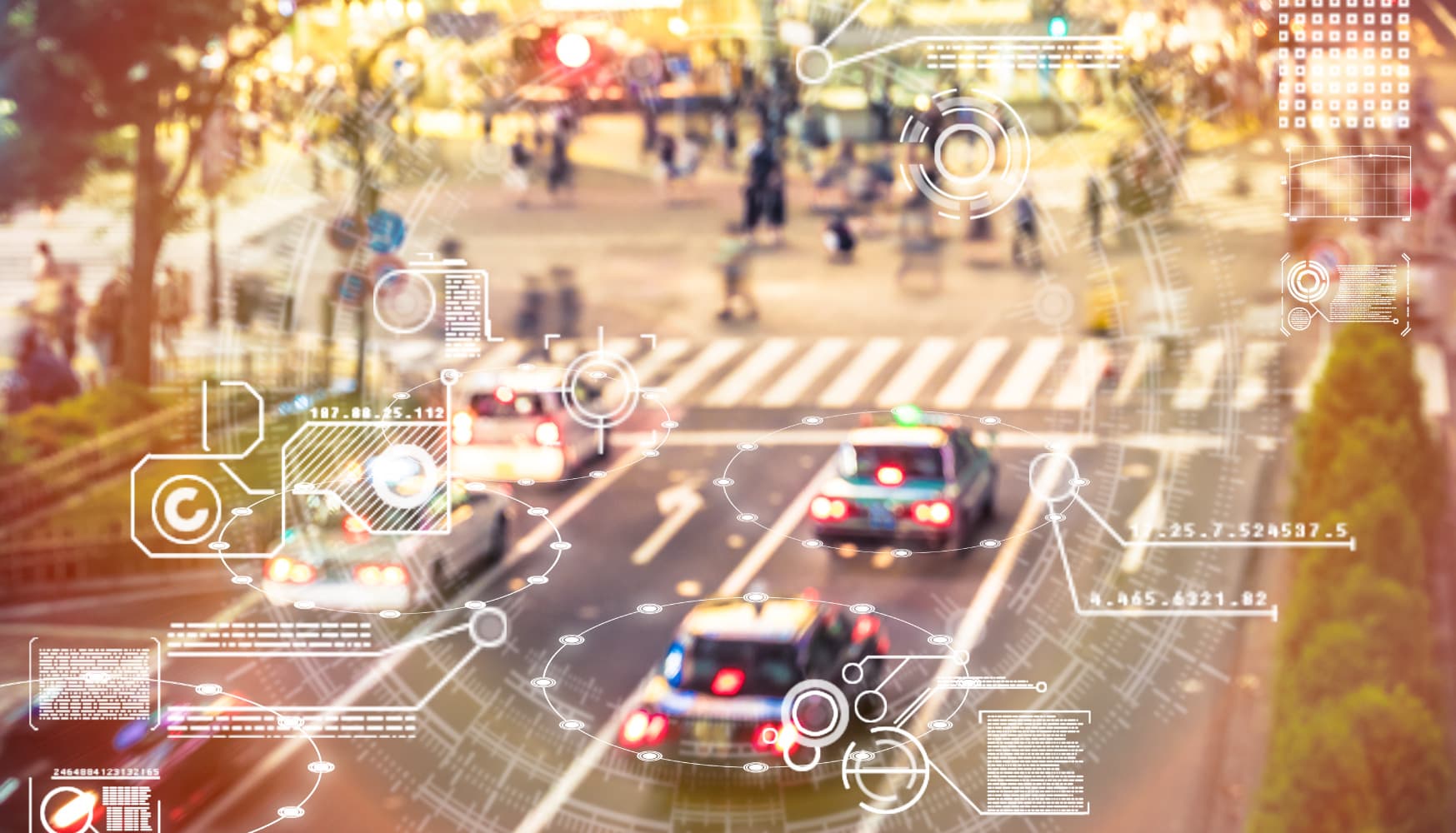
From a technological point of view, smart mobility is a combination of an advanced mobile and fixed infrastructure. Think of self-driving cars, but also smart traffic lights. There is also a distinction to be made between autonomous and connected systems. An autonomous self-driving car or smart traffic junction bases its behavior on the data from its own cameras and sensors. A connected vehicle or traffic-management system (also) receives information from sensors from other vehicles or from the environment. It is only when all these elements have been sufficiently developed and harmonized that we can really talk about a smart-mobility system. Or in technical terms, a Cooperative, Intelligent Transport System (“C-ITS”).
Why the traffic light is red
Everyone is probably familiar with this scenario: the local primary school is on an excursion in the city. Nearly a hundred children with fluorescent jackets cross the street, supervised by their teachers. By the time half of them have crossed the street, the pedestrian light turns red again. Some doubt and stand still. A few others still quickly cross the street. And a few remain hesitant in the middle of the intersection or even start walking back to the pavement where they came from. In a future with a smart mobility system, such situations will be a thing of the past. An AI-supported solution will not only keep the light on until the whole group has crossed. It will also anticipate the consequences of this decision and will regulate the flow of traffic at surrounding intersections in such a way that the impact is kept to a minimum.
At the same time, it will also inform car drivers why they need to make a detour, why the light remains red for a longer period of time, and how this will still optimize their final travel time.
Much of the individual technologies to make this possible already exists. Yet it will take some time before all of these separate solutions start talking to each other. One of the crucial elements to enable this is fast and reliable data exchange. An aspect in which 5G can play an important role. And sensor fusion: what does the camera of the car that is already around the corner tell me and how does my car know that it can rely on this?
From smart zone to smart region
For this purpose, Imec is deploying projects on different scales. In the Smart Zone project in Antwerp, for example, it is working on smart and safe intersections for all road users. By observing when road users ignore the red lights, the aim is to optimize the smart traffic lights according to the real needs of the traffic. A geographically larger-scale project is Mobilidata, a project in which imec, together with a large number of Flemish partners, is working on mobility and traffic safety throughout Flanders. This is a five-year project in which providers of existing AI solutions also can find great opportunities.
The proverbial dog poo
And it's not just about purely technological challenges. The emotional aspect is at least as important. Take the example of dog poo on the street. Where ten years ago it was still experienced as 'just annoying', owners now have the habit of having a bag ready as soon as their dog lowers its pelvis. A dog drool on the street is now an exception for which you can rightly get angry. However, if you hadn't stepped into anything for a week ten years ago, that didn't mean that the problem wasn't there for you anymore. You praised yourself lucky, but didn't feel that the problem had been solved. Only after years of raising awareness and a combination of measures did that overall feeling change.
The same goes for smarter and safer traffic. There are many latent problems and challenges that are similar to those of dog poo on the street. Think of punctuality of public transport, pleasant cycling, fresh air, safe public space, a vibrant city and so on. These are all aspects where not only technology, but an overall approach has to clear the differences between reality and perception and between short- and long-term sentiment.
AI will not so much be about the funky applications such as flying cars, but about supporting slower evolutions that improve the overall wellbeing.
And therein lies a hidden complexity, often masked by the simplicity of the user interface. Where technology needs to be operated more intuitively and in the background, it also needs to remain transparent and generate trust. Think of the traffic light that has been on the red for a longer period of time. By means of icons, it could provide feedback on the reason why. But while this is relatively easy to program for scenario-based software, it is much more difficult for self-learning AI systems in which not all scenarios - and therefore not all outcomes - are pre-programmed. Imec is researching a transparency engine that finds exactly the sweet spot of what information you need to display in order to give the necessary insight and confidence to the end user. Compare it to a restaurant with an open kitchen. Chances are that most customers will not look in the pots at all. But the fact that there is an open kitchen is enough to have confidence in what's on your plate.
When money makes the world go around
In logistics, there is also a specific extra dimension: data ownership and exchange. Couriers and logistics companies are terrified that their competitors are being given insight into how they plan their routes and operational planning. Because these are the essence of their cost structure and thus profit optimisation. The same applies, for example, to the development of medicines in the medical sector, where large amounts of money are spent and where the privacy of the patient plays a vital role.
As soon as the economic interests are substantial, there will be all kinds of additional obstacles to data-based applications such as AI-supported mobility.
Here, too, imec is taking steps to investigate how an answer can be found to this question. Think of installing a trusted and neutral third party that can exchange relevant data and at the same time keep the individual interests intact. And City of Things is a valuable environment for imec to develop these and other scenarios as prototypes in a real environment.
Authors

Jan Adriaenssens
Jan Adriaenssens is director of City of Things at imec. He is fascinated by the role and impact that technology has in and on society. Jan studied mathematics in Antwerp and philosophy in London. He gained experience with innovation policy as senior researcher at the Flemish Council for Science and Innovation, where he began as a consultant. After this, he went to work as deputy chief-of-staff to the Flemish minister for Innovation. Jan then joined the iMinds research center (which merged with imec in 2016), first as director Strategy & Innovation, and later as vice-president Policy & Society. After imec and iMinds merged, he took on responsibility for imec’s City of Things program, an ambitious living lab and technology laboratory.
Discover more