Imec technology taking off to space
Imec will validate three of its technologies in a spaceflight environment. Being compact and sophisticated makes these systems attractive for implementation in space.
In short
A critical hurdle facing space-based research is the limited availability of physical space, mass, and weight permitted. Nanoelectronics provide a solution to this challenge by miniaturizing core components, leading to a significant reduction in overall hardware size without compromising performance and functionality. Imec will validate three of its compact, smart nanotechnologies in a spaceflight environment.
Small technology, big challenges
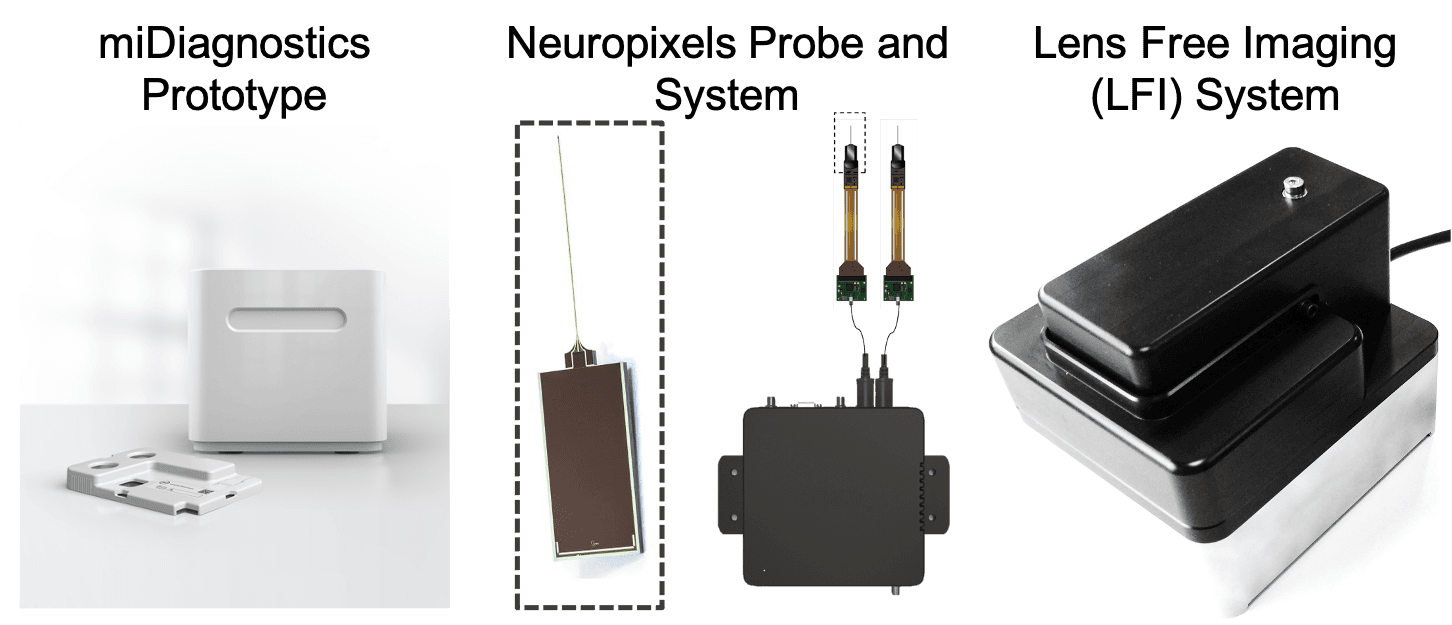
Imec is known for pushing the boundaries of technology. Now, the world-renowned R&D institute is aiming for the stars, validating imec technology in a microgravity environment. A critical hurdle facing space-based research is the limited availability of physical space, mass, and weight permitted in flight or on the International Space Station (ISS). Nanoelectronics provide a solution to this challenge by miniaturizing core components, leading to a significant reduction in overall hardware size without compromising performance and functionality. Imec spin-off miDiagnostics’ blood diagnostic device, imec’s lens-free imaging (LFI) system, and imec’s Neuropixels electrophysiology system are each compact, sophisticated systems, making them attractive for implementation in space.
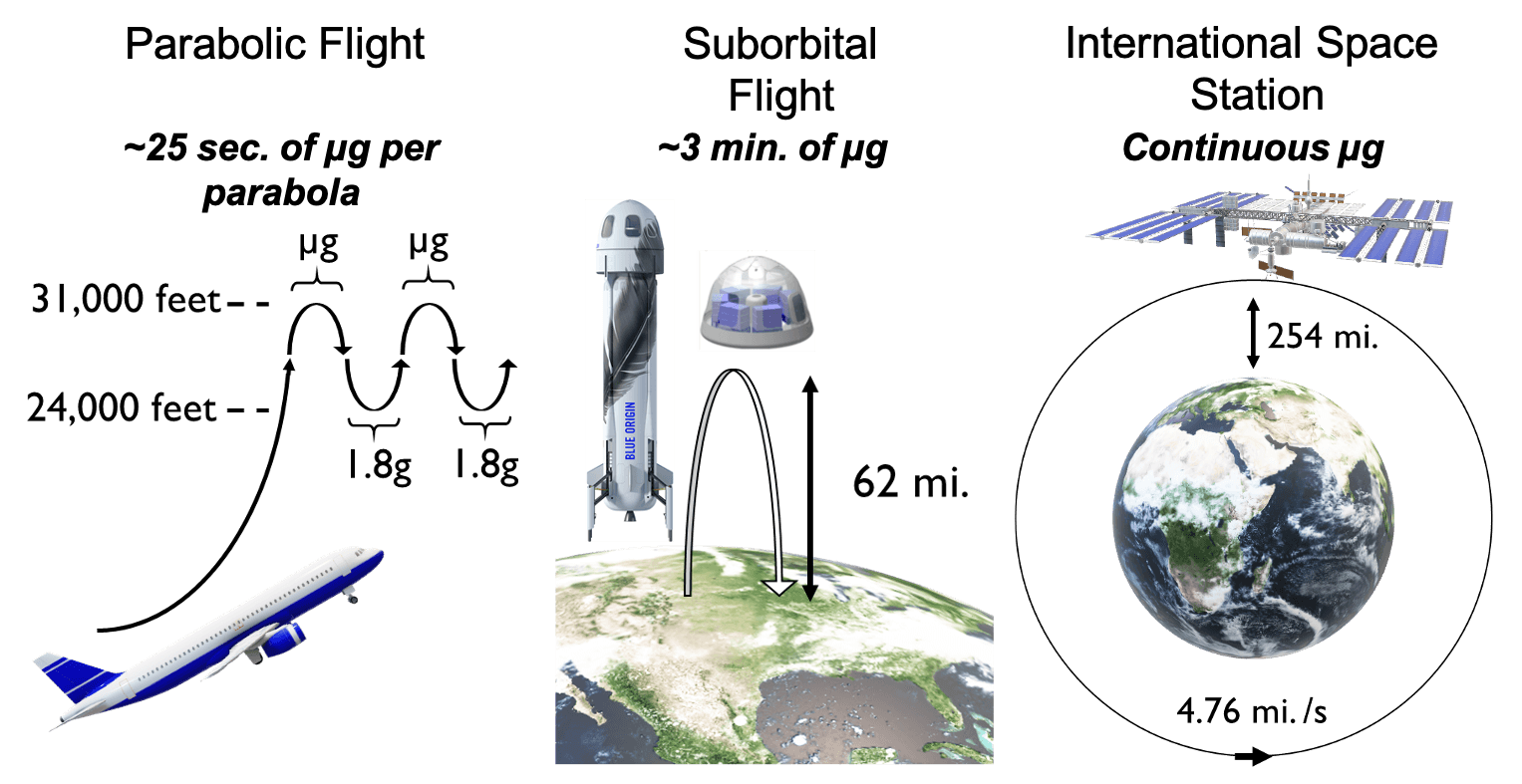
NASA’s (National Aeronautics and Space administration) STMD (Space Technology Mission Directorate) Flight Opportunities program facilitates the demonstration of promising technologies for space exploration, discovery, and the expansion of space commerce through flight testing. Its funding will enable testing of the systems in parabolic (miDiagnostics) and suborbital (Neuropixels and LFI) flight environments. These technology demonstrations will validate the use of these technologies in spaceflight environments and pave the way for eventual use aboard the ISS and on other spaceflight missions. Veerle Reumers, R&D manager at imec USA, and Candice Hovell, researcher at imec USA, talk about how imec technology can make a difference in space.
A diagnostic tool for astronauts
With an average flight duration of 5-7 months, astronauts have limited options to evaluate their health. “Currently, the process for health analysis requires that a blood sample is collected in the ISS and then sent back to Earth for analysis. That not only affects the payload –the carrying capacity of a launch vehicle– but the feedback on the results might also come back too late, or samples might be lost,” Reumers says. “Another limitation is the lack of medical professionals on board to draw and analyze blood when needed. Astronauts need to be self-reliant and perform the tests themselves. Technology, therefore, needs to be user-friendly and automated as much as possible.”
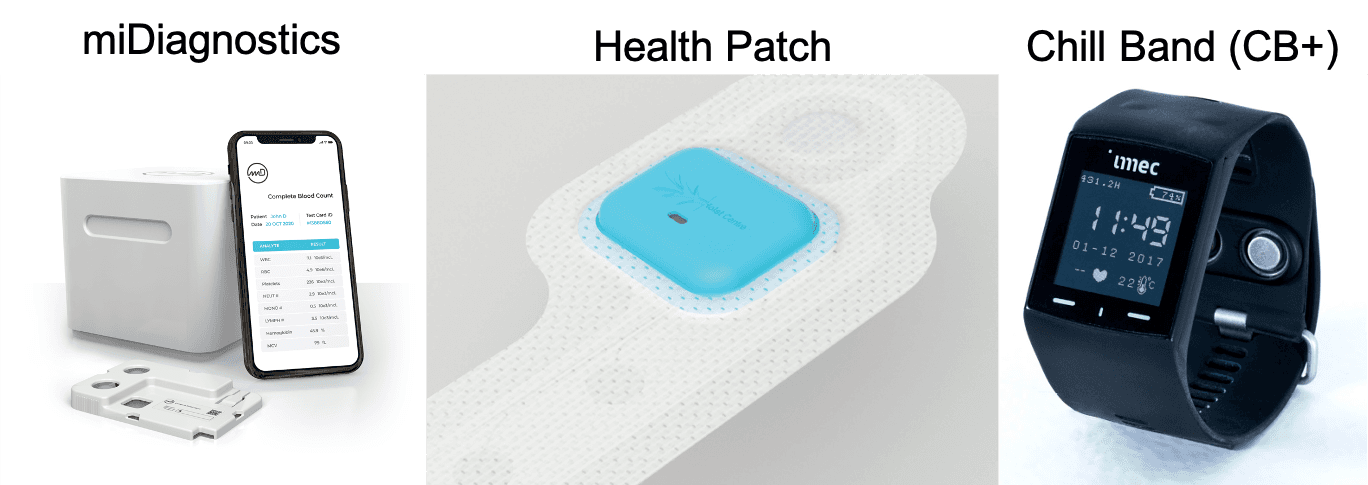
miDiagnostics, founded as a spin-off from imec and a research collaboration with Johns Hopkins University, is specialized in advanced liquid control within silicon chip technology based on capillary forces. It is developing a near-patient diagnostic platform based on a nanofluidic processor embedded in a single-use, low-cost test card. The device addresses the need for easily deployable medical devices with minimal instrumentation that can be used at the point of need. The current research prototype can perform a complete cell blood count (CBC) from only drops of blood with a fast turnaround time. In other configurations, the same platform could provide accurate and instantaneous point-of-need diagnostics for a suite of cellular, biochemical and molecular tests. Reumers says the device is expected to perform equally well in microgravity as it depends solely on capillary forces. To test performance, a drop of blood will pass through the isolated nanofluidic processor during the 20-25 seconds of microgravity in a parabolic flight (expected May 2021).
Research in space
Medical research on the ISS sheds light on the effects of long-term spaceflight on the human body, such as muscle atrophy and bone loss. For these and other research applications, collection of electrophysiological and imaging data is of crucial importance.
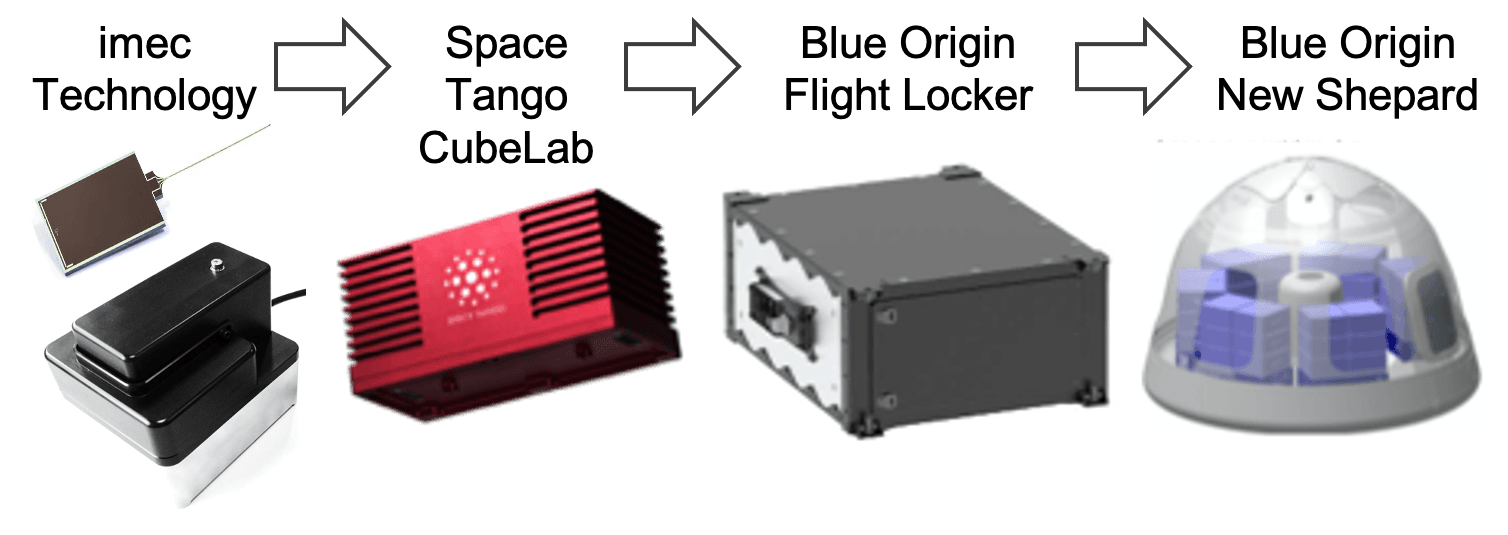
“Both the imaging and electrophysiology technology will be validated in suborbital flight via the Space Tango’s CubeLab hardware within the next 18 months,” Reumers says. The CubeLab is a compact, fully-automated, shoebox-sized ‘lab’ that can easily be plugged into different flight vehicles. It is a standardized platform that enables the translation of Earth-based technology and research to space. The suborbital rocket briefly goes into orbit but returns to Earth before one revolution is complete, guaranteeing a few minutes of microgravity to demonstrate the technology.
Imaging systems that fit in a shoebox
Current microscopic systems rely heavily on traditional optical technologies requiring the alignment and coordination of multiple mechanical parts to obtain high-quality images. In comparison, imec’s LFI system is not dependent on fragile mechanical parts, enabling robust operation in a significantly smaller form factor. The LFI operates through the principle of digital holography, where images are reconstructed afterward in software at any focal depth. This entirely eliminates stage drift during time-lapse image acquisition as there is no need for mechanical focusing. The system still enables subcellular resolution (1 µm) across a large field-of-view (6.4 x 4.6 mm2) and produces similar images to conventional phase-contrast.
“Because the LFI system is so compact, four modules can fit in the CubeLab, enabling eight different samples to be imaged simultaneously throughout the flight. The test samples range from fixed cell cultures to fixed and live model organisms to showcase the LFI system’s applicability to diverse scientific disciplines with both single and time-lapse image acquisition. Once the LFI is validated, it can image cells that act as a model to study the effects of microgravity on the human body. Additionally, the samples can report on particle transport phenomena observed in microgravity relative to ground controls,” says Reumers.
Measuring electrical activity of cells
Studies of electrically active cells, such as brain or heart cells, are largely limited to whole organism assessment before, during, and after spaceflight. While informative, these measures do not yield detailed temporal information from the electrophysiology of cells and tissues. Using the state-of-the-art Neuropixels system, imec creates the first system capable of continuous, automated monitoring of electrically active cells in spaceflight environments. Neuropixels is a CMOS digital integrated microsystem featuring 960 low impedance, low noise recording sites.
Hovell says that a multiprobe Neuropixels system will be integrated into a CubeLab to measure the electrophysiological activity of multiple in vitro neuronal network cell cultures for the duration of a suborbital flight. “This will not only validate the system but also provide a preliminary dataset to assess the effects of variable gravity conditions on neuronal network function.”
Production capabilities in microgravity
Aside from research, manufacturing in low-Earth orbit (LEO) is gaining increasingly more interest because of the advantages of microgravity. Minimization of gravitational forces enables the production of goods that either could not be produced on Earth or that can be made with superior quality. For example, the lack of sedimentation and limited convective forces at play in the microgravity environment enable enhanced growth of larger, higher-quality crystals in solution. This is particularly relevant for applications such as drug compound production and target receptor discovery. In addition, uniformity for fabrication of silicon wafers or retinal implants using a layer-by-layer deposition processes is enhanced in microgravity.
Additionally, since a reduction in gravity also provides a weightless environment, space might be the ideal location for certain 3D printing applications or for the production of artificial organs fabricated by additive manufacturing techniques. “In the long term, we plan to also implement other imec technologies such as our miniaturized analysis systems (hyperspectral imaging sensors and chip-based Raman spectrometer) to enable collection of high content data throughout the development and execution of such manufacturing processes and for use in microreactor chemistry for on-demand production of a variety of compounds including pharmaceutical, chemical and rocket fuels” says Reumers.
From exploration to settlement
While research and manufacturing support space exploration and development of a robust commercial space economy in low-Earth orbit (LEO), space colonization is also on the long-term agenda of space agencies and private companies alike. For both exploration, settlement and terrestrial applications, the technology requirements place compactness and automatization on top of the list. Technology must allow astronauts and future space citizens to be self-sustainable. They need to be able to monitor their own health and be self-sufficient in producing everything they need. At the same time, because the payload is limited, tools need to be small and lightweight, and with relatively few people, automation will be key.
Personalized medicine has the potential to be transformative to the diagnosis and treatment of diseases. “In deep space, there is little room for trial and error, so knowing the effect of medication on your body upfront is essential. For astronaut monitoring, contact and non-contact sensors might be employed, while tools such as the miDiagnostics platform could be used for regular checkups,” Reumers says.
A future for imec healthcare technology in space
The spaceflight tests, and research in ISS and LEO also provide a stepping stone to future missions in deep space and settlements. Such missions might happen in a distant future, but researchers are already preparing for them.
In the long term, advanced stem cell technology could be combined with the astronauts’ own cells to enable the production of microphysiological systems for personalized drug testing. The electrophysiology platform integration project will provide validation of the Neuropixels tool for future integration into such microphysiological systems. In the shorter term, the miDiagnostics validation project will confirm the functionality of a compact analysis platform for rapid blood testing in space.
Want to know more?
- Learn more about imec technology for health monitoring in space:
- Imec USA website
- Article space exploration
- Article NASA grant
- More information about LFI, you can find here.
- More information about the Neuropixels probe and other electrophysiology technology, you can find here:
- Imec website neural probes
- Neuropixels website
- Imec website MEA
- More information about the hyperspectral technology in space, you can find here.
- Blommaert et al. CHIEM: A new compact camera for hyperspectral imaging. Conference on small satellites, Utah, 2017. (Available upon request).
- More information about miDiagnostics, you can find here.
- Learn more about NASA, Space Tango and Blue origin
Discover more

Imec participates in ELENA L.E.U.V.E.N. project and is committed to the evolution towards a climate neutral Leuven
Read more





Belgian security researchers from KU Leuven and imec demonstrate serious flaws in Tesla Model X keyless entry system
Read more