Perovskite/CIGS tandem cell with Record Efficiency of 24.6 percent Paves the Way for Flexible Solar Cells and High-Efficiency Building-Integrated PV
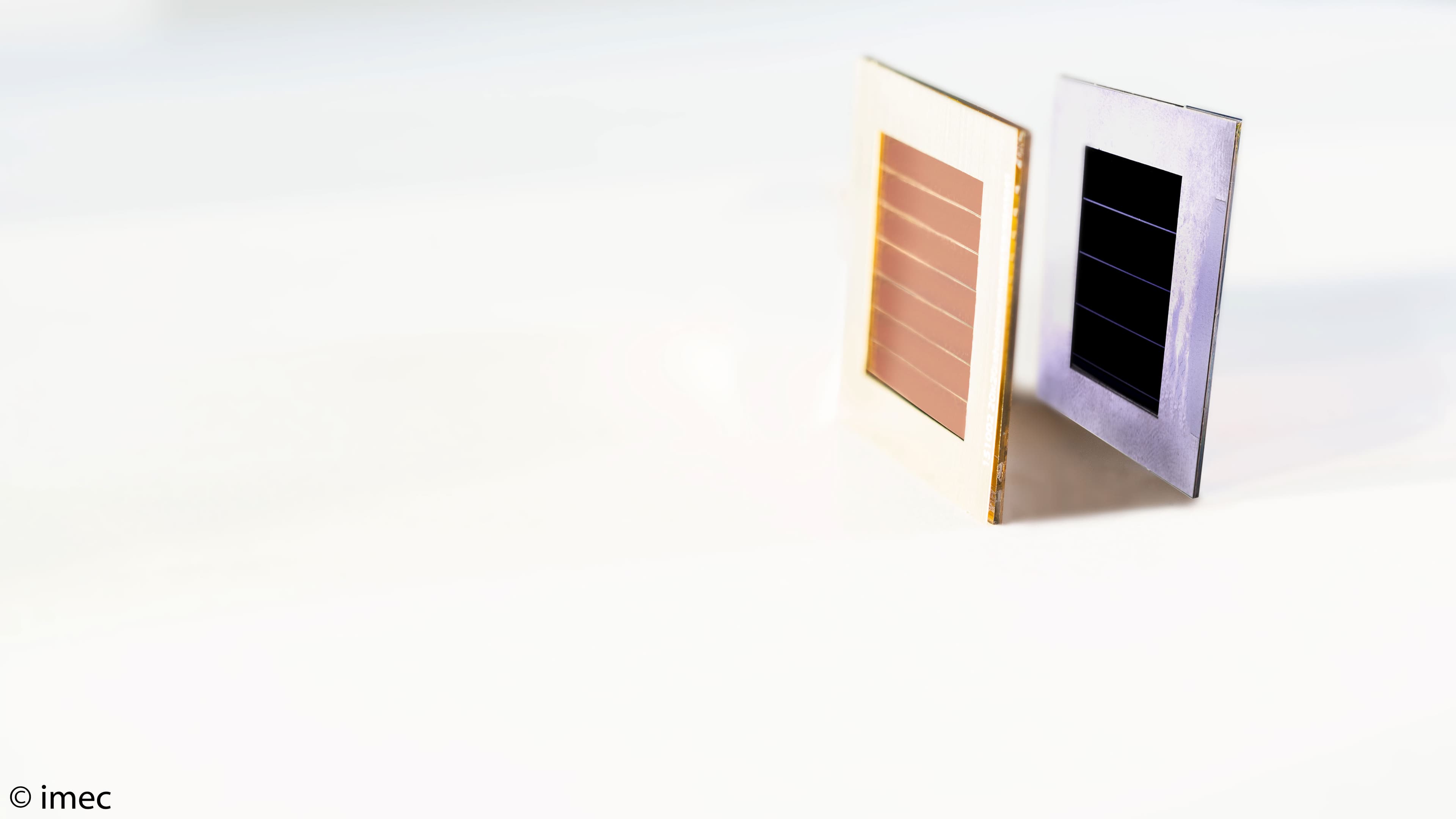
BRUSSELS (Belgium), SEPTEMBER 24, 2018 — Today at the EU PVSEC conference, imec, the world-leading research and innovation hub in nanoelectronics, energy and digital technologies, presents a thin-film tandem solar cell consisting of a top perovskite cell developed by imec within the partnerships of EnergyVille and Solliance, and a bottom CIGS cell from the Centre for Solar Energy and Hydrogen Research (ZSW, Stuttgart, Germany). The tandem cell resulting from this collaboration achieves a record efficiency of 24.6 percent.
The perovskite top cell in the tandem uses light in the visible part of the solar spectrum, while the light in the near-IR spectrum that passes through the perovskite cell is harvested by the underlying CIGS cell. In this way, the tandem cell significantly outperforms the stand-alone perovskite and CIGS cells. Moreover, both perovskite and CIGS cells are thin-film solar cells, paving the way to high efficiency flexible solar cells and building integrated photovoltaic (BIPV) solutions.
The 4-terminal tandem consists of a perovskite solar cell stacked on top of a CIGS cell, based on a fully scalable device concept to enable industrial adoption of the process. The new record efficiency of 24.6 percent was achieved thanks to several innovations. First of all, the transmittance of the perovskite cell for near-IR light was improved by adding optical coupling layers to the tandem stack and by optimizing the transparent electrodes. Secondly, the perovskite itself was optimized in terms of a wide bandgap of 1.72eV for higher tandem efficiency.
The CIGS cell of 0.5cm² size has been made at the high-efficiency line at ZSW, employing all optimized processes necessary for the preparation of record devices. It thus was the ideal sample for combination with the perovskite cell. Further improvements of the technology will ultimately pave the way to thin-film tandem solar cells with efficiencies of more than 30 percent.
“We work on two types of tandem cells,” explains Tom Aernouts, group leader for thin-film photovoltaics at imec/EnergyVille. “We combine our state-of-the-art perovskite technology with silicon or CIGS bottom cells. The advantage of CIGS is that it is a thin-film technology, just like perovskite, and that the tandem cells therefore can be fabricated in a wide variety of shapes and sizes. This makes it possible to use this technology in building-integrated PV applications. Future work will focus on upscaling the technology towards larger modules. Moreover, we will also look into developing solutions for 2-terminal cells because of their importance to the PV industry. In the end, it’s the adoption of our results by our industrial partners that’s important.”
“We owe the record efficiency to two factors,” says Prof. Dr. Michael Powalla, member of the board and head of the Photovoltaics Division at ZSW. “On the one hand to the improved perovskite cell, on the other hand to one of the world’s best efficiencies for CIGS cells. There are several parameters of the CIGS cell which we can optimize with regard to its combination with the perovskite top cell. Thus, we expect even better efficiency values in the future, paving the way to further cost reductions.”
This achievement results from a lasting international collaboration of imec, ZSW and Karlsruhe Institute of Technology.
About imec
Imec is the world-leading research and innovation hub in nanoelectronics, energy and digital technologies. The combination of our widely acclaimed leadership in microchip technology and profound software and ICT expertise is what makes us unique. By leveraging our world-class infrastructure and local and global ecosystem of partners across a multitude of industries, we create groundbreaking innovation in application domains such as healthcare, smart cities and mobility, logistics and manufacturing, energy and education.
Imec is a partner in EnergyVille (www.energyville.be). EnergyVille is a collaboration of the Flemish research centers KU Leuven, VITO, imec and UHasselt in the field of sustainable energy and intelligent energy systems, and a partner in Solliance (www.solliance.eu), a partnership of R&D organizations from the Netherlands, Belgium and Germany working in thin film photovoltaic solar energy.
As a trusted partner for companies, start-ups and universities we bring together more than 4,000 brilliant minds from over 85 nationalities. Imec is headquartered in Leuven, Belgium and has distributed R&D groups at a number of Flemish universities, in the Netherlands, Taiwan, USA, China, and offices in India and Japan. In 2017, imec's revenue (P&L) totaled 546 million euro. Further information on imec can be found at www.imec-int.com.
Imec is a registered trademark for the activities of IMEC International (a legal entity set up under Belgian law as a "stichting van openbaar nut”), imec Belgium (IMEC vzw supported by the Flemish Government), imec the Netherlands (Stichting IMEC Nederland, part of Holst Centre which is supported by the Dutch Government), imec Taiwan (IMEC Taiwan Co.) and imec China (IMEC Microelectronics (Shanghai) Co. Ltd.) and imec India (Imec India Private Limited), imec Florida (IMEC USA nanoelectronics design center).
About Solliance
Solliance is a partnership of R&D organizations from the Netherlands, Belgium and Germany working in thin film photovoltaic solar energy (TFPV). In order to strengthen the region’s position as a world player in PV, Solliance is creating the required synergy by consolidating and coordinating the activities of 250 researchers in industry, at research institutes and universities.
Various state-of-the-art laboratories and pilot production lines are jointly used for dedicated research programs which are executed in close cooperation with the solar business community.
Solliance partners are: ECN, imec, TNO, Holst Centre, TU/e, Forschungszentrum Jülich, University Hasselt and Delft University of Technology.
Solliance offers participation in its research programs and opens up its lab facilities to new entrants, either from industry or in research. On the basis of clear Intellectual Property (IP) agreements, each industrial partner can participate in this research effort, or alternatively, hire equipment and experts to further develop its own technology.
About ZSW
The Zentrum für Sonnenenergie- und Wasserstoff-Forschung Baden-Württemberg (Centre for Solar Energy and Hydrogen Research Baden-Württemberg, ZSW) is one of the leading institutes for applied research in the areas of photovoltaics, renewable fuels, battery technology, fuel cells and energy system analysis. There are currently around 250 scientists, engineers and technicians employed at ZSW’s three locations in Stuttgart, Ulm and Widderstall. In addition, there are 90 research and student assistants.
Contact
Claudia Brusdeylins, Zentrum für Sonnenenergie- und Wasserstoff-Forschung Baden-Württemberg (ZSW) / Centre for Solar Energy and Hydrogen Research (ZSW), Meitnerstr. 1, 70563 Stuttgart, Tel. +49 711 7870-278, claudia.brusdeylins@zsw-bw.de, www.zsw-bw.de
About Energyville
EnergyVille is a collaboration between the Flemish research partners KU Leuven, VITO, imec and UHasselt in the field of sustainable energy and intelligent energy systems. Our researchers provide expertise to industry and public authorities on energy-efficient buildings and intelligent networks for a sustainable urban environment. This includes, for example, smart grids and advanced district heating and cooling.
One of the objectives of EnergyVille is to become one of the top five European institutes in innovative energy research. In this context, the center was embedded in major national and international networks right from the start. It covers research, development, training and innovative industrial activities under one name and in close collaboration with local, regional and international partners.
EnergyVille aims to be a driver in the Thor science park in Genk in the areas of research, business development and employment creation. The research center is supported by the city of Genk, the Flemish Government, the Province of Limburg, LRM, Nuhma, POM Limburg and the European structural funds.
Discover more


Imec and Diraq demonstrate first coherent operation of eight silicon MOS spin qubits fabricated in a 300mm CMOS-compatible foundry process
Read more

Neural telemetry breakthrough: new chip delivers ten-fold compression while preserving signal integrity
Read more