Imec and Holst Centre Present Solution for Precise Low-Cost Eye Movement Detection
Technology Paves the Way to Low-Cost Augmented Reality and Virtual Reality Applications

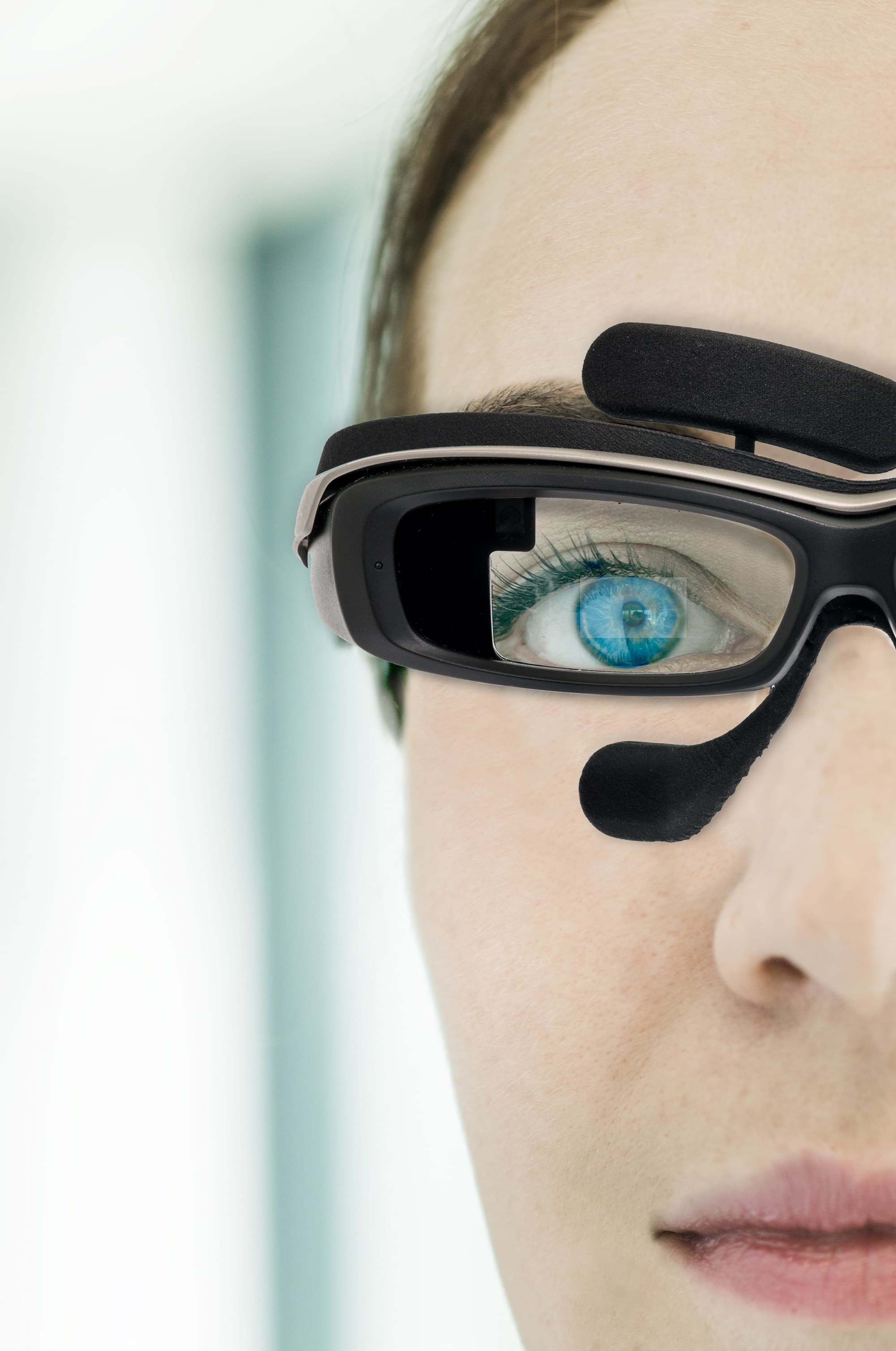
ANTWERP, Belgium – May 16, 2017 – Imec, the world-leading research and innovation hub in nanoelectronics and digital technologies, and Holst Centre (set up by imec and TNO) today announced the development of a sensing technology to detect eye movement in real time based on electrical sensing. Paving the way for the next generation of eye-tracking technology, imec’s solution has promising applications in the fields of virtual and augmented reality.
Today’s eye movement detection technology makes use of high-resolution cameras embedded in eye-tracking screens or glasses. Such devices are already being commercialized for numerous applications, including healthcare, research and gaming.
While camera-based solutions can accurately determine where users are looking, most cameras’ frame rates are not fast enough to match the eye’s most rapid movements, such as saccades – a typical movement during reading. Using a more sophisticated camera that matches the eyes’ speed would significantly increase the already high cost of these devices and could have implications for their commercial use. Imec’s solution, based on electrical sensing, offers a much more inexpensive alternative, while solving the issue of the image processing delay.
Imec’s sensors were integrated into a set of glasses, with four built-in electrodes around each lens, two to pick up the eye’s vertical movement and two for horizontal movements. Parallel to that, an advanced algorithm was developed to translate the signals into a concrete position, based on the angle the eye is making with its central point of vision. Imec’s solution also offers insights on the eye’s behavior, like the speed of movement or the frequency and duration of blinks.
“Human eyes have a natural electrical potential”, stated Gabriel Squillace, researcher in the Biomedical Applications & Systems group at imec. “At imec, we are leveraging this feature to develop the next-generation of eye-movement detection devices that can detect the eye’s position in real time at a five times lower cost and up to four times faster than what is currently available on the market. Imec’s ultimate goal is to develop a solution that can track the eye’s most rapid movements, such as saccades, enabling seamless real time tracking for AR and VR applications.”
Other possible applications for this technology include a complement to current camera-based solutions, potentially developing cheaper and faster eye-movement detection devices.
Currently being tested and showing promising results on eye behavior and blink detection, users are able to interact with screens by moving the cursor with their eyes and using different blinking patterns for distinct actions, such as selecting files, drag-and-dropping or opening and closing applications.
About imec
Imec is the world-leading research and innovation hub in nano-electronics and digital technologies. The combination of our widely acclaimed leadership in microchip technology and profound software and ICT expertise is what makes us unique. By leveraging our world-class infrastructure and local and global ecosystem of partners across a multitude of industries, we create groundbreaking innovation in application domains such as healthcare, smart cities and mobility, logistics and manufacturing, and energy.
As a trusted partner for companies, start-ups and universities we bring together close to 3,500 brilliant minds from over 75 nationalities. Imec is headquartered in Leuven, Belgium and also has distributed R&D groups at a number of Flemish universities, in the Netherlands, Taiwan, USA, China, and offices in India and Japan. In 2016, imec's revenue (P&L) totaled 496 million euro. Further information on imec can be found at www.imec-int.com
Imec is a registered trademark for the activities of IMEC International (a legal entity set up under Belgian law as a "stichting van openbaar nut”), imec Belgium (IMEC vzw supported by the Flemish Government), imec the Netherlands (Stichting IMEC Nederland, part of Holst Centre which is supported by the Dutch Government), imec Taiwan (IMEC Taiwan Co.) and imec China (IMEC Microelectronics (Shanghai) Co. Ltd.) and imec India (Imec India Private Limited), imec Florida (IMEC USA nanoelectronics design center).
About Holst Centre
Holst Centre is an independent R&D center that develops technologies for wireless autonomous sensor technologies and flexible electronics, in an open innovation setting and in dedicated research trajectories. A key feature of Holst Centre is its partnership model with industry and academia based around roadmaps and programs. It is this kind of cross-fertilization that enables Holst Centre to tune its scientific strategy to industrial needs.
Holst Centre's fundamentals are to contribute to answering global societal challenges in healthcare, lifestyle, sustainability and the Internet of Things. This is visible through the motivation of its researchers, its different collaboration models and the choice of its research topics.
Holst Centre was set up in 2005 by imec (Flanders, Belgium) and TNO (The Netherlands) and is supported by local, regional and national governments. Located on High Tech Campus Eindhoven, Holst Centre benefits from, and contributes to, the state-of-the-art on-site facilities. Holst Centre has over 200 employees from some 28 nations and a commitment from more than 50 industrial partners. For more information visit www.holstcentre.com.
Contact
Hanne Degans, Press Officer,+32 16 28 17 69 // +32 486 06 51 75 // Hanne.Degans@imec.be
Discover more


Imec and Diraq demonstrate first coherent operation of eight silicon MOS spin qubits fabricated in a 300mm CMOS-compatible foundry process
Read more


Neural telemetry breakthrough: new chip delivers ten-fold compression while preserving signal integrity
Read more