Three proof-of-concepts for edge-AI
In the short term, imec will centralize the research on edge-AI around three concrete use cases: anomaly detection, closed loop control and operator detection and tracking. In each of these scenarios, concrete proof-of-concepts will be developed over the next three years. Where possible, intermediate results should already be transferable to concrete industrial applications from the first year.

The first scenario, anomaly detection, focuses on the monitoring of industrial processes in order to detect irregularities in products or events and to intervene before a defect or obstruction occurs. This requires, amongst others, that existing (or new) sensors should operate at a higher sampling rate. Nowadays, the status of a process or machine is often transferred to the control room at relatively long intervals. In order to respond quickly, this frequency has to be increased (over 50KHz). And this within the existing limits of the energy budget or other critical parameters of the system.
The acquired knowledge will not only be applicable in industrial scenarios such as predictive maintenance, but also in related sectors such as healthcare and wearables, security, etc.
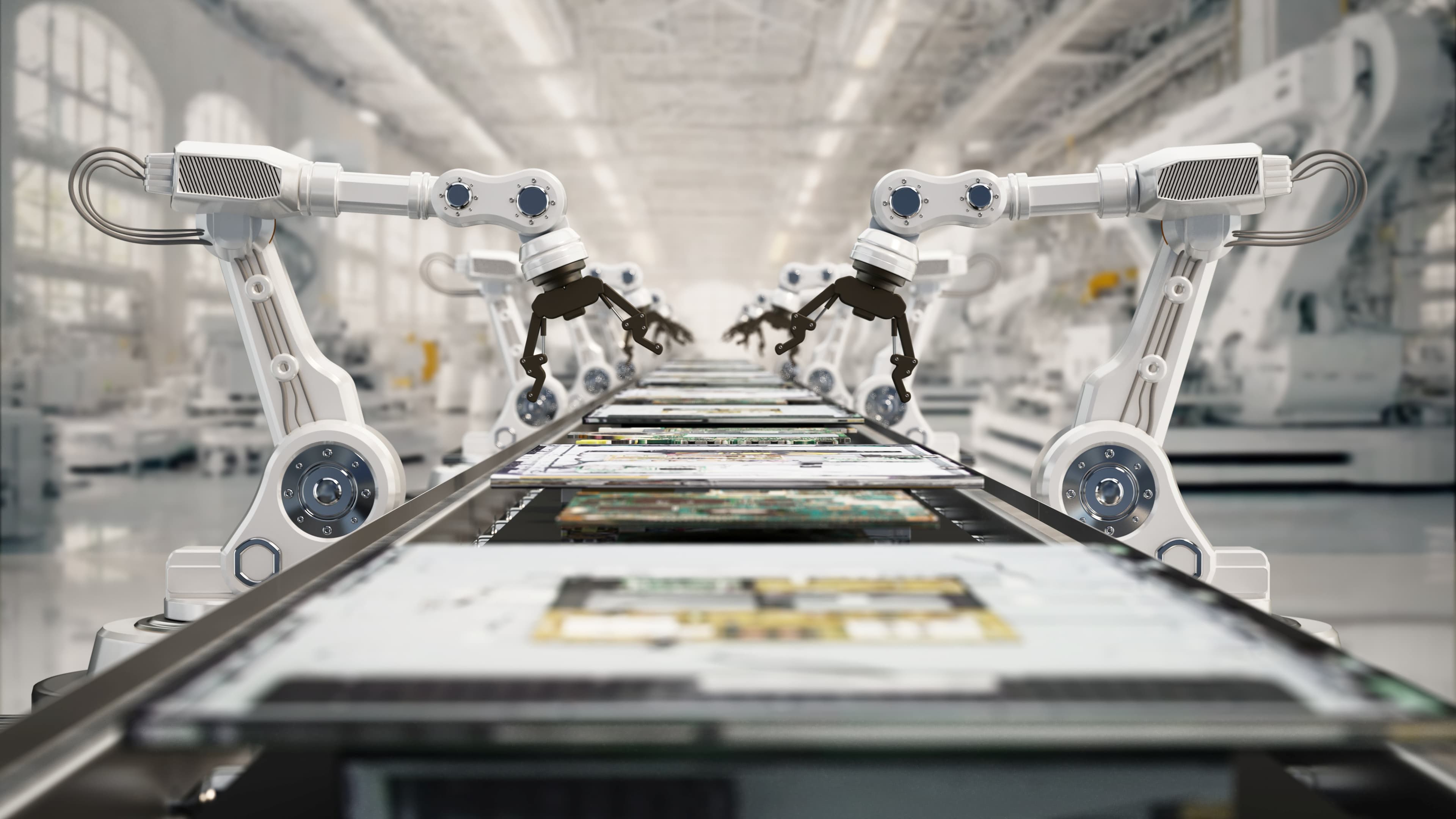
The second case, closed loop control, focuses on adjusting control parameters of industrial machines and robots based on real-time measurements. For example, to allow people to work more easily in the vicinity of such robots. Now they often operate in a safety cage that switches the robot off as soon as someone opens the cage. To make this scenario possible, further development is needed of, for example, the camera and Lidar infrastructure with which robots can map their environment. As well as algorithms that can react without delay (low latency) to changes in their environment. This typically has to be done faster than 10 milliseconds and can therefore not be done in the cloud.
Besides in the proposed scenario, the technology from this use case can also be applied in sectors such as smart intersections, augmented-reality (AR) supported maintenance, etc.
Also closely related is the third proof-of-concept that imec will develop: the detection and tracking of operators in environments where people and machines work together, such as flexible assembly lines. Compared to the second use case, where they work side by side, such collaboration requires even more advanced development of the sensor environment in order to align the movements of man and machine. Also sensor fusion, combining data from multiple sources in order to obtain a more accurate picture of reality, then becomes incresignly relevant. And all this within the limits of the available bandwidth to send and process data.
Insights that are not only useful for human-machine interactions, but also for example to track pedestrians at intersections, customers in shops, employees and (self-driving) vehicles in warehouses, etc.
In order to bring all this, and possibly more, to a successful conclusion, imec can count on the cooperation of partners in the AI impulse program, such as the University of Ghent, the University of Antwerp, Flanders Make and KU Leuven.
Want to know more?
Read more about the challenges related to edge AI in the September 2018 issue of imec magazine: Bringing artificial intelligence to the edge of the IoT.
Authors

Rudy Lauwereins
Rudy Lauwereins is vice president at imec responsible for the digital and user-centric solutions unit, which focuses on security, connectivity, image processing, sensor fusion, machine learning, data analytics and on making technology society proof. He is also director of the imec.academy, coordinating external and internal technical training curricula. Rudy is a part-time professor at the KU Leuven (Belgium) and has authored and co-authored more than 400 peer reviewed publications in international journals, books and conference proceedings. He is a fellow of the IEEE.
Discover more