3 reasons why Bluetooth channel sounding will transform distance measurement and its applications


Channel sounding is a new technique to assess the distance between two Bluetooth devices. It uses the phase-based ranging method:
- Two Bluetooth devices ('radios') communicate back and forth in an organized way (‘ping-pong’).
- This procedure is repeated over several frequencies to eliminate ambiguities and optimize accuracy.
- One of the devices analyzes the signals’ phase to determine the distance between the radios.
Bluetooth channel sounding is an upcoming feature that will become available on an increasing number of Bluetooth devices. It breaks barriers when it comes to accuracy, security, and flexibility. This will transform existing micro-location use cases, such as digital (car) locks and contactless payments. And it will give rise to new ones, such as highly precise item tracking in warehouses.
Is your product ready for the revolution in high-accuracy location services?
1. Bluetooth channel sounding brings ranging accuracy towards 10cm
Existing Bluetooth ranging technologies are well-established and will continue to be useful. But for more challenging applications, their distance measurements are too imprecise:
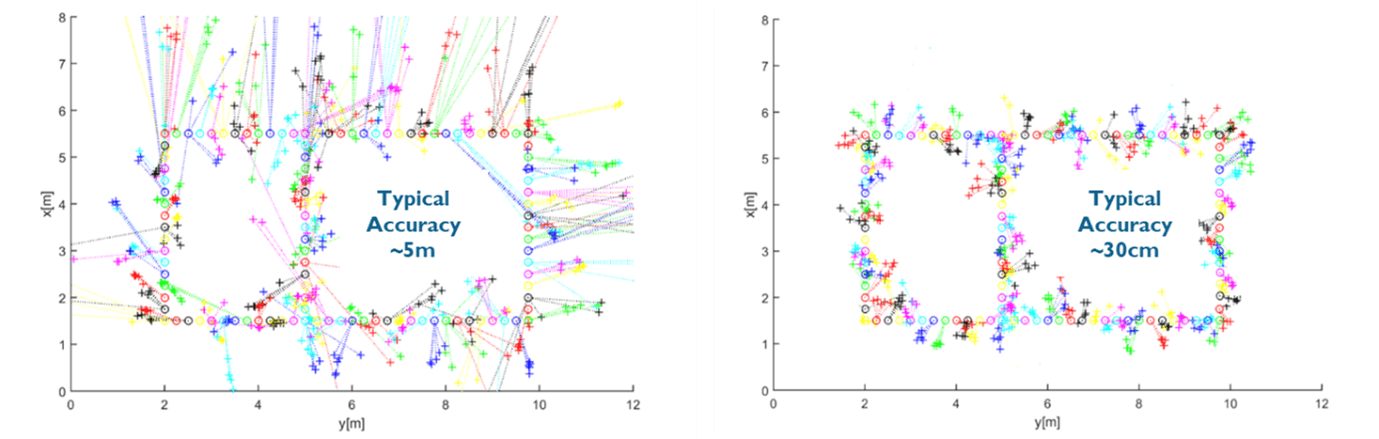
- The received signal strength indicator (RSSI) method is present on all smartphones. It calculates the distance between two devices based on the decline of the signal's amplitude. The accuracy of this technique is low, no better than three to five meters. It’s also vulnerable to interference by obstacles.
- Angle of arrival (AoA) and angle of departure (AoD) don’t make direct estimations of distance but derive these – through trigonometry – from the angles of incoming or outgoing radio signals, respectively. This allows distance assessments with a precision below one meter. However, that accuracy can vary significantly due to surrounding circumstances, for instance, reflecting surfaces in indoor environments (multipath propagation).
Compared to these techniques, channel sounding leaps towards 10-cm accuracy. It’s important to note that different algorithms can transform phase measurement data into distance estimates – each with specific trade-offs in, for instance, accuracy and energy use. For highly challenging indoor environments, super-resolution algorithms are already available.
Imec is ready to assist your company in selecting or adapting a high-accuracy ranging algorithm tailored to your application.
Get in touch to set up a meeting
2. Bluetooth channel sounding enables enhanced security
Micro-location use cases such as smart locks contribute to our comfort. But they also come with new security risks. The most evident of these is the relay attack, where an attacker gets access to a device by falsifying the proximity of the ‘prover’ to the ‘verifier.’
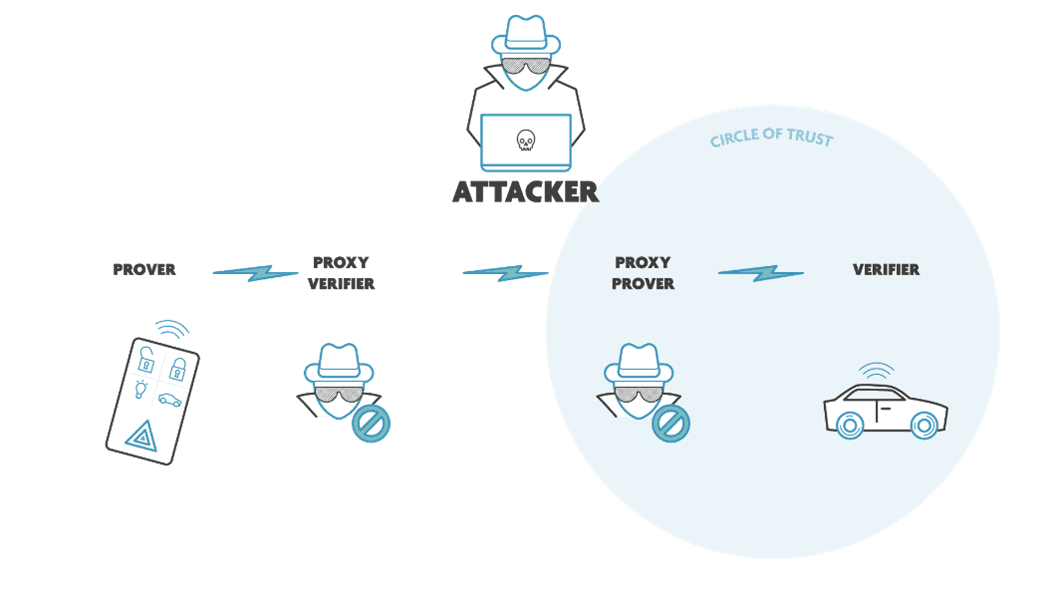
Because such a relay attack can be performed without knowledge of the transmitted data, it cannot be prevented using cryptography. Sufficient safety can only be achieved using secure distance bounding protocols that allow a device to authenticate another device and securely ascertain its physical proximity.
Imec has developed a secure distance bounding protocol for Bluetooth radios that leverages the high-accuracy ranging capabilities of channel sounding. This protocol sets up a strong defense against (future) methods for relay attacks, such as phase manipulation and early-detect/late-commit (ED/LC). Its feasibility and practicality have been established by implementing the solution on an NXP KW36 BLE radio platform.
3. Bluetooth channel sounding offers maximum flexibility
As mentioned, channel sounding is a feature that will gradually become available in most Bluetooth devices. This means application developers will quickly have easy access to a secure, low-cost, and accurate ranging solution without needing additional chipsets. And they can choose a positioning algorithm that best suits their needs.
But what if an application requires even greater accuracy than Bluetooth channel sounding can deliver? Then ultra-wideband (UWB) with time-of-flight (ToF) is the only alternative, reaching even sub-centimeter precision. However, UWB requires incorporating a new chipset, and its power consumption – although quickly reducing – is still significantly higher than BLE’s.
Even when using UWB, Bluetooth channel sounding will continue to play a role. When incorporated together on a single chip, BLE and UWB can perfectly complement each other by reacting to the ranging demands that best suit their abilities. For instance, BLE establishes if a distance is smaller than a given number of centimeters, and UWB only takes over if that is the case.
Want to know more about how the channel-sounding feature fits into the current Bluetooth architecture?
Are you interested in using Bluetooth channel sounding for your micro-location use case? Click the contact button below to get in touch with our experts.
Discover more
Next-gen UWB radio technology to enable radar sensing, data streaming, and advanced ranging applications
Read more
Disruptive ‘Wi-Fi on steroids’ technology allows manufacturing industry to finally cut the cord
Read more
From horsepower to high-performance compute: automotive chiplets take the leap towards autonomous edge computing
Read more
Strategic alignment between imec and Japan’s ASRA aims to harmonize standardization of automotive chiplet architectures
Read more