Glasses that keep an eye on your health
Imec/Holst Centre have developed spectacles that can detect eye movements. While this can be of use for Virtual Reality applications, it also opens up possibilities for early detection of neurodegenerative diseases such as Alzheimer’s or Parkinson’s.

Smart watches, necklaces and... glasses
We’re all familiar with fitness trackers for your wrist which measure your heart rate, the distance you walk or cycle, the number of steps you take, etc. Or think of those alarms worn by seniors – integrated in a discrete necklace or wristwatch – to automatically notify family members in the event of an emergency (e.g. falling).
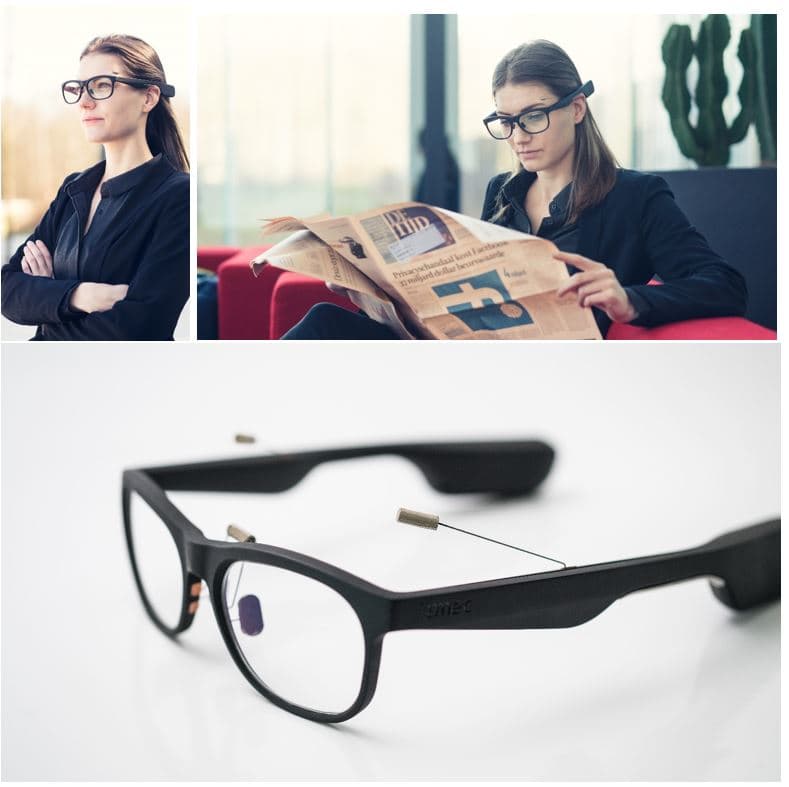
Because these clever electronics can be made so small, they can be incorporated into just about anything: a watch, a necklace – and even into the frame of your glasses. Imec and Holst Centre have produced just such a pair of smart glasses with integrated electronics to detect your eye movements.
How do you make glasses like these cheap and yet stylish?
Eye-tracking glasses have been around for a while. In the main they use cameras that are built into the spectacles. These glasses are very accurate, but are rather expensive – plus the cameras tend to be too big to be easily concealed in a standard frame.
Imec and Holst Centre decided to take a different approach. No cameras, but little soft electrodes – five in total – at specific locations around the eyes: above and on the sides of the nose and then above the eyes.
The electrodes measure the difference in electrical voltage between the front and back of the eye. These measurements are then used to calculate eye movement. The advantage of this technology – called electro-oculography – and using electrodes is that you can produce cheaper and more energy-efficient glasses than with cameras. What is also important is that the electrodes and the associated electronic module (for processing and sending signals wirelessly) can be invisibly integrated into the frame of a standard pair of glasses.

The electrodes measure the difference in electrical voltage between the front and back of the eye. These measurements are then used to calculate eye movement.
From Virtual Reality to Parkinson’s
So, why would you want to measure eye movements with a pair of glasses? Well, this information can be used in glasses for both AR (augmented reality) and VR (virtual reality) in which you see images or additional information appear in your line of vision. You can then manipulate the images shown – just as you would operate your computer using a mouse – by blinking or by moving your eyes from left to right, etc.
This kind of eye-tracking glasses can also be of interest for medical applications, for example for diagnosing and treating eye problems, or for early detection of neurological disorders, such as Parkinson’s or Alzheimer’s disease. Medical literature states that eye movements in these diseases are affected by the brain disorder. Imec will now be working with companies and medical experts to see how the smart glasses can be used for medical purposes.
Authors

Chris Van Hoof
Chris Van Hoof is vice president of R&D, Connected Health Solutions at imec and leads teams at three different imec sites (Eindhoven, Leuven and Ghent). Imec's Connected Health Solutions teams create solutions for monitoring patients with chronic conditions and for preventive medicine using virtual coaches. Chris has brought wearable health within imec from fundamental research to a fully-fledged business line, with international customers and partners. Chris wants to develop products that really work and that are relevant for the industry, which has already led to the creation of five imec start-ups (4 in the field of health).
Chris obtained his PhD at KU Leuven in 1992, in collaboration with imec. He held various positions as manager and director in different research domains (sensors, image sensors, 3D integration, MEMS, energy harvesters, body sensor networks, biomedical electronics, portable health sensors). He is also a professor at KU Leuven.
Discover more


Imec and Diraq demonstrate first coherent operation of eight silicon MOS spin qubits fabricated in a 300mm CMOS-compatible foundry process
Read more

Neural telemetry breakthrough: new chip delivers ten-fold compression while preserving signal integrity
Read more